How Much Can a 2023 Toyota Tacoma Tow?
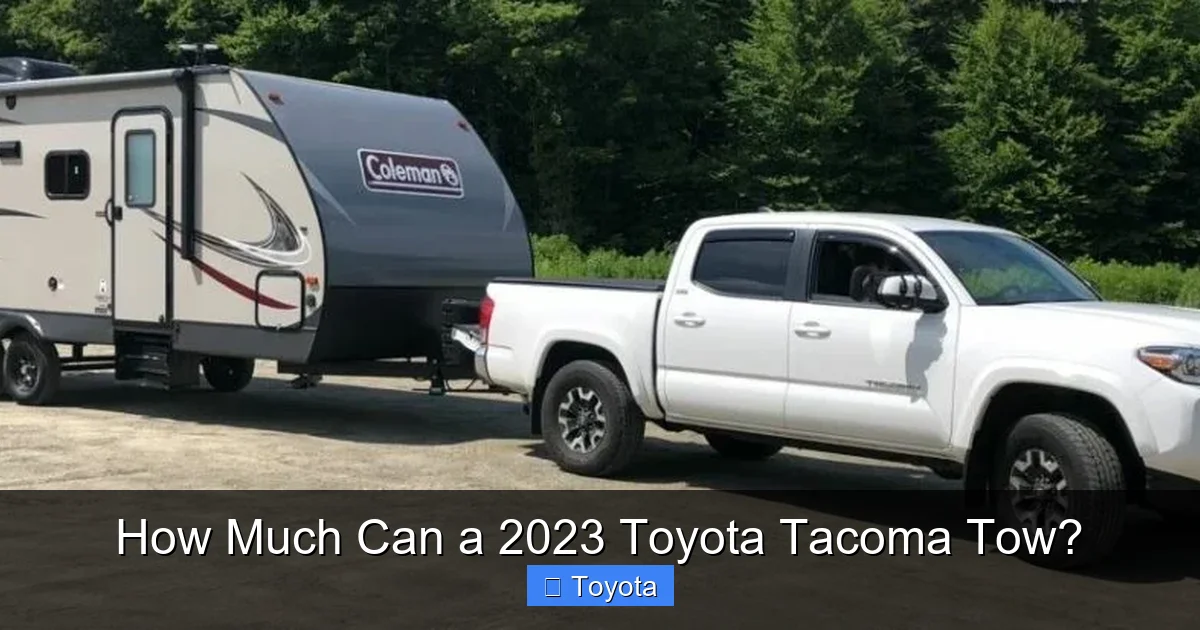
The 2023 Toyota Tacoma can tow between 3,500 and 6,800 pounds depending on the configuration. The maximum rating requires the V6 engine, rear-wheel drive, and the Tow Package. Always check your specific truck’s door sticker for exact limits before you hitch up a trailer.
Key Takeaways
- Max Tow Rating: The 2023 Tacoma peaks at 6,800 lbs with the V6, RWD, Access Cab, and Tow Package.
- Engine Matters: The 4-cylinder engine maxes out at 3,500 lbs, while the V6 handles significantly more weight.
- Tow Package Required: You must have the factory Tow Package (hitch, cooler, wiring) to achieve the highest ratings.
- Payload Counts: Tongue weight reduces your available payload for passengers and gear inside the cab.
- 4WD Reduces Capacity: Adding four-wheel drive typically drops the tow rating by 200–300 lbs due to added weight.
- Trailer Brakes Needed: Toyota requires trailer brakes for anything over 1,000 lbs for safe stopping.
- Check the Sticker: Your specific truck’s GVWR and GCWR are on the driver’s door jamb; never exceed those numbers.
📑 Table of Contents
- Introduction: Know Before You Tow
- Understanding Towing Capacity Basics
- 2023 Toyota Tacoma Towing Capacity by Configuration
- The Tow Package: What It Is and Why You Need It
- Factors That Reduce Your Real-World Towing Capacity
- Essential Towing Equipment for Your Tacoma
- Tips for Safe Towing with a 2023 Tacoma
- Maintenance Intervals When Towing
- Conclusion: Tow Smart, Stay Safe
Introduction: Know Before You Tow
So you have a 2023 Toyota Tacoma and you want to pull a trailer. Maybe it is a small camping trailer for a weekend trip. Maybe it is a boat for the lake. Or maybe you need to haul a utility trailer for work. The first question on your mind is simple: how much can a 2023 Toyota Tacoma tow? The answer is not a single number. It changes based on the engine, the cab style, the bed length, and whether you have two-wheel drive or four-wheel drive.
Towing is about more than just a maximum number on a spec sheet. It is about safety, stability, and staying legal. If you exceed your truck’s limits, you risk damaging the drivetrain, losing control on the highway, and voiding your warranty. In this guide, we break down every configuration for the 2023 model year. We explain the equipment you need. And we give you practical tips to tow with confidence.
We will look at the difference between the four-cylinder and the V6. We will explain why the Tow Package is non-negotiable for heavy loads. And we will show you how to read your door jamb sticker so you never guess again. Let us dive in.
Understanding Towing Capacity Basics
Before we look at the specific numbers for the 2023 Tacoma, we need to define a few terms. These acronyms appear on your window sticker and your door jamb. Knowing them keeps you safe.
GVWR (Gross Vehicle Weight Rating)
This is the maximum weight your truck can weigh when fully loaded. That includes the truck itself, all passengers, cargo in the bed, fuel, and the tongue weight of the trailer. You must never exceed this number.
GCWR (Gross Combined Weight Rating)
This is the maximum allowable weight of your loaded truck plus your loaded trailer combined. If your GCWR is 11,360 lbs and your loaded truck weighs 5,500 lbs, your trailer can weigh up to 5,860 lbs. This is often the real limiting factor for towing.
Curb Weight
This is the weight of the truck as it sits on the dealer lot with a full tank of fuel and standard fluids. No passengers, no cargo. Heavier trims (like the TRD Pro) have higher curb weights, which leaves less room for payload and tongue weight.
Payload Capacity
Payload = GVWR minus Curb Weight. This is the total weight of people, gear, and trailer tongue weight you can add. Many Tacoma owners focus on the tow rating but forget payload. A heavy trailer tongue can eat your payload fast.
Tongue Weight
This is the downward force the trailer coupler puts on the hitch ball. The rule of thumb is 10% to 15% of the loaded trailer weight. If you tow a 5,000 lb trailer, expect 500 to 750 lbs on the hitch. That weight counts directly against your payload.
2023 Toyota Tacoma Towing Capacity by Configuration
The 2023 Tacoma comes with two engine choices: a 2.7L four-cylinder (159 hp, 180 lb-ft) and a 3.5L V6 (278 hp, 265 lb-ft). The V6 is the only way to get the maximum tow rating. The four-cylinder is only rated for 3,500 lbs regardless of other options.
Below are the maximum tow ratings for the V6 models when equipped with the Tow Package. Ratings assume the driver only. Add passengers and gear, and your real-world capacity drops.
Access Cab (Extended Cab) / 6-Foot Bed
- 2WD (RWD): 6,800 lbs (The maximum possible)
- 4WD: 6,500 lbs
Double Cab (Crew Cab) / 5-Foot Bed
- 2WD (RWD): 6,700 lbs (SR, SR5) / 6,500 lbs (TRD Sport, TRD Off-Road, Limited)
- 4WD: 6,400 lbs (SR, SR5) / 6,300 lbs (TRD Sport) / 6,200 lbs (TRD Off-Road, Limited, TRD Pro)
Double Cab / 6-Foot Bed (Long Bed)
- 2WD (RWD): 6,500 lbs
- 4WD: 6,200 lbs
Four-Cylinder Models (All Configurations)
- Max Tow Rating: 3,500 lbs
- Tow Package Availability: Not available on 4-cylinder models.
Notice the trend? Two-wheel drive always tows more than four-wheel drive. The Access Cab tows more than the Double Cab. Lower trim levels (SR, SR5) often tow slightly more than heavier trims (TRD Pro, Limited) because they weigh less. If you need absolute maximum towing, a base SR Access Cab 2WD V6 with the Tow Package is the king of the hill.
The Tow Package: What It Is and Why You Need It
You cannot achieve the ratings listed above without the factory Tow Package. It is not just a hitch receiver. It is a system engineered to handle the heat and stress of heavy towing. If you buy a Tacoma without it, your max tow rating drops to 3,500 lbs (V6) or stays at 3,500 lbs (4-cylinder).
What the Factory Tow Package Includes
- Class IV Hitch Receiver: Rated for the max capacity.
- Engine Oil Cooler: Critical for keeping oil temps down under load.
- Transmission Cooler: The 6-speed automatic generates serious heat when towing. This cooler is essential.
- Power Steering Cooler: Helps maintain steering assist at high temps.
- 130-Amp Alternator: Keeps the battery charged while running trailer lights and brakes.
- 7-Pin and 4-Pin Wiring Harness: Plug-and-play for trailer lights and electric brakes.
- Trailer-Sway Control (TSC): Integrated with the stability control system. It applies individual wheel brakes and reduces engine torque if the trailer starts to sway.
Can You Add It Later?
You can install an aftermarket hitch, wiring, and coolers. But it is expensive and complicated. You would need to add the transmission cooler, engine oil cooler, and upgraded alternator to truly match the factory rating. Most dealers cannot “add” the factory package after the truck is built. If you think you will tow over 3,500 lbs, buy the truck with the package installed.
Factors That Reduce Your Real-World Towing Capacity
The numbers in the brochure are best-case scenarios. They assume a 150-lb driver, no cargo, and a perfectly balanced trailer. Real life is different. Here is what eats into your capacity.
Passengers and Cargo
Every pound of passenger, dog, cooler, or toolbox in the cab or bed subtracts from your available payload. Remember, tongue weight counts as payload. If your payload capacity is 1,300 lbs and you have 400 lbs of people and gear, you only have 900 lbs left for tongue weight. That limits you to roughly a 6,000–9,000 lb trailer (at 10–15% tongue weight), provided you don’t hit the GCWR limit first.
Four-Wheel Drive Weight Penalty
4WD adds a transfer case, front differential, and driveshaft. That adds roughly 200–300 lbs to the curb weight. That weight comes straight off your payload and GCWR allowance. That is why 4WD models have lower tow ratings.
Trim Level Weight
A TRD Pro has heavier suspension, skid plates, wheels, and tires. A Limited has more luxury features. A base SR is the lightest. The heavier the truck, the less it can tow. Check the specific curb weight of the exact truck you are buying.
Altitude and Temperature
Engines lose power at high altitude (roughly 3% per 1,000 feet). If you tow in the mountains, your effective capacity drops. Extreme heat also stresses the cooling system. The factory coolers help, but physics wins eventually. Downshift early, watch your gauges, and slow down.
Essential Towing Equipment for Your Tacoma
Having the Tow Package gets you the wiring and the cooling. You still need the right hitch components and safety gear. Do not skimp here.
Weight Distribution Hitch (WDH)
Toyota recommends a weight distribution hitch for trailers over 5,000 lbs. A WDH uses spring bars to transfer some tongue weight from the rear axle to the front axle and the trailer axles. This restores front-wheel traction for steering and braking. It also levels the truck. If your rear sags and your headlights point at the trees, you need a WDH.
Trailer Brake Controller
If your trailer weighs over 1,000 lbs (some sources say 1,500 lbs, but 1,000 is safer), electric trailer brakes are required by law in most states. The 2023 Tacoma with the Tow Package has a built-in brake controller plug under the dash. You just need the controller unit (like a Tekonsha Prodigy P3 or the OEM Toyota unit). It lets you adjust brake gain manually or automatically.
Extended Towing Mirrors
The stock mirrors on a Tacoma are not wide enough to see down the side of a wide travel trailer. You need clip-on extensions or replacement mirrors with built-in extension. Being able to see your trailer tires and traffic beside you is non-negotiable for safe lane changes.
Tire Pressure Monitoring
Your truck’s TPMS only monitors the truck tires. Get a separate TPMS for the trailer tires. A blowout on a heavy trailer at 65 mph is terrifying. Early warning saves lives and equipment.
Tips for Safe Towing with a 2023 Tacoma
You have the right truck. You have the right hitch. Now drive smart.
Load the Trailer Correctly
Put 60% of the cargo weight in front of the trailer axles. This ensures proper tongue weight (10–15%). Too little tongue weight causes dangerous sway. Too much overloads the rear axle and lifts the front wheels. Scale your loaded rig at a CAT scale to be sure.
Use the Right Gear
The 6-speed automatic is smart, but it hunts for gears on hills. Use the sequential shift mode (move the shifter to “S” or use paddle shifters if equipped) to lock out 6th gear and often 5th gear on grades. Keep RPMs in the 3,000–4,000 range for engine braking downhill and power uphill. This saves your brakes and transmission.
Engage Tow/Haul Mode
The 2023 Tacoma V6 has a Tow/Haul button on the shifter. Press it. It changes shift points, holds gears longer, and activates engine braking. It also adjusts the Trailer Sway Control sensitivity. Use it every time you tow.
Check Your Brakes Before You Leave
Do a “brake check” at 10 mph in an empty parking lot. Apply the trailer brake controller manually. You should feel the trailer tugging the truck back smoothly. If it grabs or does nothing, adjust the gain.
Slow Down and Increase Following Distance
Stopping distance increases dramatically with a heavy trailer. Double your following distance. Take corners wider. Accelerate gently. Pretend you are driving a semi-truck, because in terms of physics, you basically are.
Know Your 4WD Limits
If you have 4WD, use 2WD (2HI) for normal highway towing. Only use 4HI for slippery boat ramps, snow, or loose gravel. Never use 4HI on dry pavement; it binds the drivetrain. If you get stuck on a ramp, shift to 4LO for maximum torque at low speed. Remember to shift back to 2HI when you are on solid ground. If you need help disengaging, check our guide on how to get a Toyota Tacoma out of 4 wheel drive.
Monitor Your Temperatures
Watch the coolant temp gauge and the transmission temp gauge (available in the multi-information display). If they climb toward the red, pull over safely, shift to Park or Neutral, rev the engine slightly to 1,500 RPM to spin the water pump and trans pump faster, and let the fans do their job. Do not shut off the engine immediately; let it idle to circulate coolant.
Understand Your Safety Systems
The 2023 Tacoma comes with Toyota Safety Sense P (TSS-P). This includes Pre-Collision System, Lane Departure Alert, and Dynamic Radar Cruise Control. Turn off Dynamic Radar Cruise Control when towing. The system does not account for the extra stopping distance of a trailer. It may brake too late. The Lane Departure Alert can be annoyed by the wider stance of a trailer; you can turn sensitivity down or off. The Pre-Collision System remains active and is a good backup. Also, the RSCA (Roll-Sensing Curtain Airbags) system is designed to deploy in a rollover. If you are off-roading with a trailer at extreme angles, you may want to disable it temporarily. Learn more about what the RSCA button on a Toyota Tacoma does.
Maintenance Intervals When Towing
Towing is “severe duty” in the eyes of the maintenance schedule. You must service your Tacoma more often.
- Transmission Fluid: Inspect every 15,000 miles. Change every 30,000 miles if towing regularly. The factory fluid is “World Standard” (WS). Use only Toyota WS fluid.
- Engine Oil: Change every 5,000 miles or 6 months with synthetic 0W-20. Check the level before every trip. If you want to know how to check the oil life monitor, see our article on how to check oil percentage in a Toyota Tacoma.
- Differential Fluid (Rear and Front if 4WD): Change every 15,000–30,000 miles. Towing heats the gears up fast.
- Brake Fluid: Flush every 2 years. Trailer braking adds heat to the truck’s brake fluid via the master cylinder.
- Coolant: Inspect at every oil change. The pink Super Long Life Coolant is good for 100,000 miles initially, but towing degrades it faster.
Conclusion: Tow Smart, Stay Safe
The 2023 Toyota Tacoma is a capable mid-size truck. With the V6 and the Tow Package, it can handle most boats, campers, and utility trailers with ease. But the numbers on the window sticker are just the starting point. Your real limit is the combination of GCWR, GVWR, and payload.
Weigh your loaded truck. Weigh your loaded trailer. Do the math. Ensure your tongue weight is in the 10–15% sweet spot. Use a weight distribution hitch if you are near the top of the range. Install a brake controller. And drive like you have a trailer behind you—because you do.
If you stick to these guidelines, your Tacoma will tow reliably for years. It is a tough truck. Treat it right, maintain it well, and it will take you and your toys wherever the road leads. Happy trails.
Frequently Asked Questions
What is the maximum towing capacity of a 2023 Toyota Tacoma?
The maximum towing capacity for a 2023 Toyota Tacoma is 6,800 pounds. This requires the 3.5L V6 engine, rear-wheel drive (2WD), Access Cab configuration, 6-foot bed, and the factory Tow Package. All other configurations tow less.
Can a 2023 Tacoma with the 4-cylinder engine tow 5,000 lbs?
No. The 2.7L four-cylinder engine is rated to tow a maximum of 3,500 pounds regardless of cab style, bed length, or drive type. The Tow Package is not available on four-cylinder models. You need the V6 for heavier loads.
Does the 2023 Tacoma come with a brake controller?
The 2023 Tacoma with the Tow Package includes the wiring harness and a plug for a brake controller under the dash. It does not include the controller unit itself. You must purchase an aftermarket or OEM controller separately and plug it in.
Is a weight distribution hitch required for a Tacoma?
Toyota recommends a weight distribution hitch for trailers over 5,000 lbs. It is required for some higher trim levels at lower weights. Check your owner’s manual for the specific requirement for your exact configuration. It improves stability and braking significantly.
How does 4WD affect the 2023 Tacoma tow rating?
Adding four-wheel drive reduces the maximum tow rating by approximately 200 to 300 pounds compared to the equivalent 2WD model. This is due to the added weight of the 4WD components (transfer case, front differential, driveshaft) which reduces payload and GCWR margin.
Can I tow in overdrive (6th gear) with a 2023 Tacoma?
It is not recommended to tow heavy loads in 6th gear (overdrive). The transmission may hunt between 5th and 6th, generating heat. Use the Tow/Haul mode or manually shift to “S” mode and limit the top gear to 4th or 5th depending on grade and load. This keeps RPMs up and temps down.