What Does H4f Mean on a Toyota 4runner?
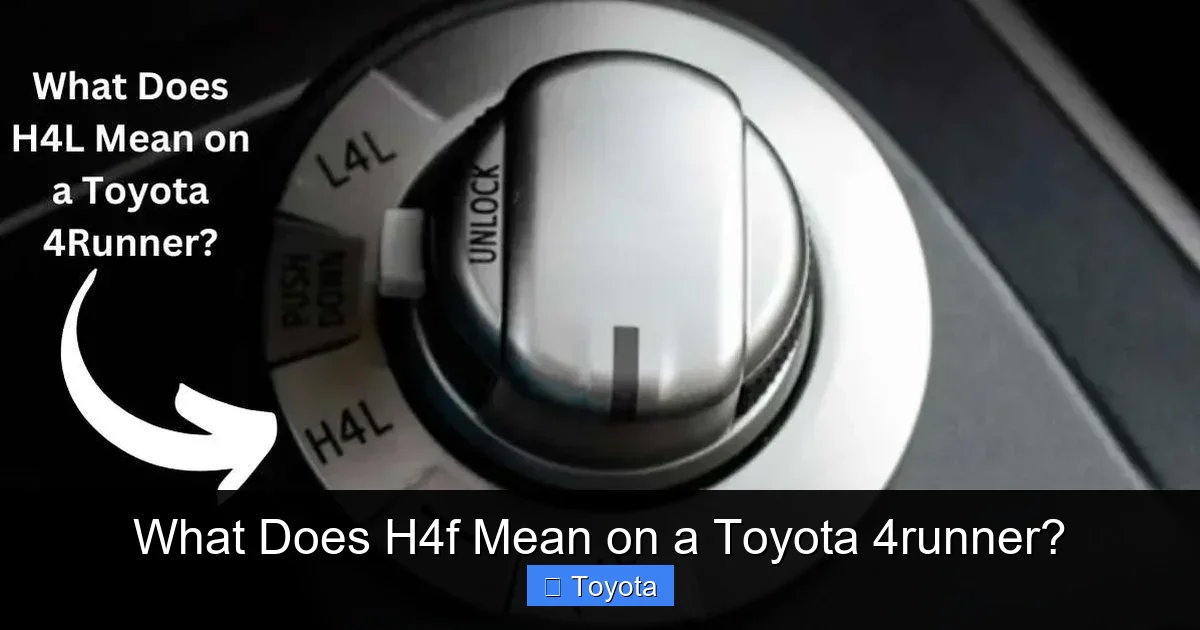
H4F on a Toyota 4Runner stands for High 4-wheel drive Full-time. It allows the vehicle to run in four-wheel drive on dry pavement without damaging the drivetrain. This mode is great for wet roads and light snow, but it is not meant for serious off-roading.
Key Takeaways
- H4F definition: H4F means High range, 4-wheel drive, Full-time, allowing safe four-wheel drive use on paved roads.
- Center differential: In H4F, the center differential stays unlocked so front and rear axles can spin at different speeds on pavement.
- Best conditions: Use H4F for rain, light snow, icy roads, and loose gravel where extra traction helps but speeds stay moderate.
- Not for hardcore trails: For rock crawling, deep mud, or steep off-road descents, switch to H4L or L4 instead of H4F.
- Shifting: You can usually shift into H4F while driving at low speeds, but always check your owner’s manual for your model year.
- Warning lights: If the H4F indicator flashes or will not engage, there may be a transfer case or sensor issue needing diagnosis.
- Related systems: H4F works alongside traction and stability controls, such as the VSC TRAC system on your 4Runner.
📑 Table of Contents
What Does H4F Mean on a Toyota 4Runner?
If you have ever looked at your Toyota 4Runner’s dashboard or transfer case selector and noticed the letters H4F, you might wonder what they stand for. You are not alone. Many 4Runner owners see this indicator and are unsure whether it is safe to drive in that mode, when to use it, or how it differs from other four-wheel drive settings. Understanding H4F is important because using the wrong 4WD mode at the wrong time can cause drivetrain wear or leave you with less traction than you need.
The Toyota 4Runner is built for adventure. Whether you are heading to the mountains, driving through a snowstorm, or just dealing with a rainy commute, the 4WD system gives you options. H4F is one of those options, and it plays a specific role in the 4Runner’s drivetrain. In this guide, we will break down exactly what H4F means, when to use it, how to shift into it, and how it compares to other modes like H4L and L4.
Think of this as a friendly conversation about your 4Runner’s transfer case. No complicated engineering jargon, just clear answers so you can drive with confidence.
Breaking Down the Letters H-4-F
H4F is shorthand for High range, 4-wheel drive, Full-time. Let’s look at each part:
- H stands for High range. This means the transfer case is using the higher gear ratio, which is normal for everyday driving speeds.
- 4 stands for 4-wheel drive. Power is being sent to both the front and rear axles.
- F stands for Full-time. The center differential is unlocked, allowing the front and rear axles to rotate at different speeds.
Because the center differential is unlocked, H4F can be used on dry pavement without causing binding or drivetrain damage. That is the key difference between H4F and locked 4WD modes. When you see H4F lit up on your dash, your 4Runner is in four-wheel drive, but it is still safe to drive on regular roads.
Where You Will See H4F
Depending on your model year, H4F may appear on the instrument cluster, on a transfer case dial, or near the gear shifter. Older 4Runners with a manual transfer case lever often have markings for H4F, H4L, N, and L4. Newer models with electronic dials may show H4F as an indicator light when the system is engaged. If you are not sure where to look, check your owner’s manual for the exact location on your specific 4Runner.
H4F vs Other 4WD Modes
Toyota 4Runners typically offer several transfer case settings. Knowing how H4F compares to H4L, L4, and H2 helps you pick the right mode for the road ahead.
H4F vs H4L
H4L means High range, 4-wheel drive, Locked. In this mode, the center differential is locked, forcing the front and rear axles to spin at the same speed. That is excellent for off-road traction, but it can damage the drivetrain if you drive on dry pavement for long distances. H4F, on the other hand, keeps the center differential open, so it is pavement-friendly.
H4F vs L4
L4 means Low range, 4-wheel drive. This uses a lower gear ratio for maximum torque at low speeds. It is designed for rock crawling, steep inclines, and deep mud. H4F does not provide low-range gearing, so it is not suitable for technical off-roading where you need slow, powerful wheel movement.
H4F vs H2
H2 means High range, 2-wheel drive. In this mode, only the rear wheels are powered (on most 4Runners). H2 is best for normal highway driving on dry roads because it offers better fuel economy. H4F uses more fuel and adds drivetrain load, so there is no reason to use it when conditions are dry and traction is not an issue.
Quick Comparison
- H2: Rear-wheel drive only. Best for dry pavement and fuel savings.
- H4F: Four-wheel drive, full-time, center diff unlocked. Safe on pavement, good for wet or slick roads.
- H4L: Four-wheel drive, high range, center diff locked. Off-road use only; avoid dry pavement.
- L4: Four-wheel drive, low range. Maximum torque for serious trails and slow speeds.
When to Use H4F (and When to Avoid It)
Knowing when to engage H4F can make your drive safer and protect your 4Runner’s transfer case. Here are the best situations for H4F:
- Wet roads: Rain can reduce traction, especially on highways. H4F gives all four wheels a chance to grip.
- Light snow: If there is a fresh layer of snow but the roads are not completely covered in ice, H4F helps you accelerate and brake more confidently.
- Icy conditions: Ice is unpredictable. Sending power to all four wheels improves stability when starting from a stop.
- Loose gravel or dirt: Rural roads with gravel or dirt benefit from four-wheel drive without needing the aggression of a locked differential.
You should avoid H4F in these scenarios:
- Deep mud or rock crawling: H4F lacks the torque multiplication of L4 and the axle locking of H4L. You will likely get stuck.
- High-speed off-roading: H4F is not designed for fast desert runs or aggressive trail driving.
- Dry pavement for extended periods: While H4F is safe on pavement, there is no benefit to running it all the time. It increases fuel consumption and wear.
A helpful way to remember H4F is to think of it as your all-weather daily driver mode. If you would turn on your windshield wipers, H4F is probably a good choice. If you are heading into the backcountry, save H4L or L4 for the trail.
How to Shift Into H4F
Shifting into H4F on a Toyota 4Runner is usually straightforward, but the exact steps depend on whether your model has a manual lever or an electronic dial. Always consult your owner’s manual for your specific year, but here is the general process.
Shifting While Driving vs Stopped
On many 4Runners, you can shift into H4F while driving at low speeds, typically under 50 mph. You do not need to come to a complete stop. However, shifting into L4 or H4L often requires the vehicle to be stopped or moving very slowly with the transmission in neutral. H4F is the most flexible mode for on-the-fly changes.
Step-by-Step Instructions
- Make sure your 4Runner is moving at a moderate speed or is completely stopped, depending on your manual’s guidance.
- Move the transfer case selector or turn the dial to the H4F position.
- Wait for the H4F indicator light on the dashboard to stop flashing and stay solid.
- Drive normally. You should feel improved traction if the road is slick.
If the light keeps flashing after you shift, the system may not have engaged fully. Ease off the accelerator, straighten the steering wheel, and try again. If it still will not engage, there could be a mechanical or electronic issue.
If you want a more detailed walkthrough for your specific model, you can check out this guide on how to put your 4Runner in 4-wheel drive. It covers the shifter positions and what to expect when engaging different modes.
Common Questions and Troubleshooting
Even with a reliable Toyota 4Runner, the 4WD system can act up from time to time. Here are some common H4F concerns and what they mean.
H4F Light Flashing
A flashing H4F light usually means the transfer case is trying to shift but has not completed the move. This can happen if the drivetrain is under torque or if the wheels are spinning at different speeds. Let off the gas, drive straight for a moment, and try shifting again. If the light continues to flash, have a technician inspect the transfer case actuator or shift motor.
H4F Won’t Engage
If H4F will not engage at all, check whether the vehicle is in park or neutral if required by your model. Low transfer case fluid, a blown fuse, or a faulty switch can also prevent engagement. It is best to address this before you actually need four-wheel drive in an emergency.
H4F and Traction Control
The 4Runner’s traction and stability systems work together with H4F. If you see the VSC or TRAC lights come on while using H4F, the vehicle may be limiting wheel spin to keep you stable. This is normal behavior. If those lights stay on or you want to disable the system temporarily for off-road use, you can learn more about the VSC TRAC light on a 4Runner and how it interacts with your drive modes.
H4F vs the Snow Button
Some Toyota SUVs have a dedicated snow button that adjusts throttle response and shift points for slippery conditions. The 4Runner does not always have this button because its transfer case modes, including H4F, handle traction differently. If you are curious about how snow buttons work on other Toyotas, you can read about the snow button on a Toyota Highlander to see the contrast.
Maintaining Your 4Runner’s Transfer Case
To keep H4F working reliably, your transfer case needs occasional attention. Here are a few maintenance tips:
- Change the fluid: Transfer case fluid breaks down over time. Follow your maintenance schedule for fluid changes to keep shifts smooth.
- Use the system regularly: Engage H4F once in a while, even in dry weather, to keep the components lubricated and prevent seals from drying out.
- Listen for noises: Grinding, whining, or clunking when shifting into H4F can signal low fluid or worn components.
- Check for leaks: If you see reddish fluid under your 4Runner, it could be transfer case fluid. Address leaks quickly to avoid expensive repairs.
Conclusion
H4F on a Toyota 4Runner means High range, 4-wheel drive, Full-time. It is a versatile mode that lets you use four-wheel drive on wet, snowy, or loose surfaces without harming your drivetrain. Unlike locked modes such as H4L or low-range L4, H4F is safe for pavement and works well as an all-weather setting for everyday driving.
The next time you see H4F on your dash, you will know exactly what it is doing. Use it when the roads are slick, save the more aggressive modes for the trail, and keep up with transfer case maintenance. Your 4Runner is built to handle tough conditions, and understanding H4F helps you get the most out of that capability.
Frequently Asked Questions
What does H4F stand for on a Toyota 4Runner?
H4F stands for High range, 4-wheel drive, Full-time. It means the vehicle is in four-wheel drive with the center differential unlocked, making it safe to use on paved roads.
Can I drive in H4F on dry pavement?
Yes, H4F is designed for use on dry pavement because the center differential remains unlocked. However, there is no need to use it all the time when traction is already good.
When should I switch from H4F to L4?
Switch to L4 when you need maximum torque at low speeds, such as rock climbing, steep descents, or deep mud. H4F does not provide low-range gearing.
Why is my H4F light flashing?
A flashing H4F light usually means the transfer case is in the process of shifting or has not fully engaged. Let off the accelerator, drive straight, and try again. If it persists, see a mechanic.
Does H4F use more fuel than H2?
Yes. Because H4F powers all four wheels and adds drivetrain load, it typically consumes more fuel than two-wheel drive H2 mode.
Can I shift into H4F while driving?
On most Toyota 4Runner models, you can shift into H4F while driving at low speeds. Always check your owner’s manual for the correct procedure for your specific year.