Is the Toyota Ae86 a Good Car?
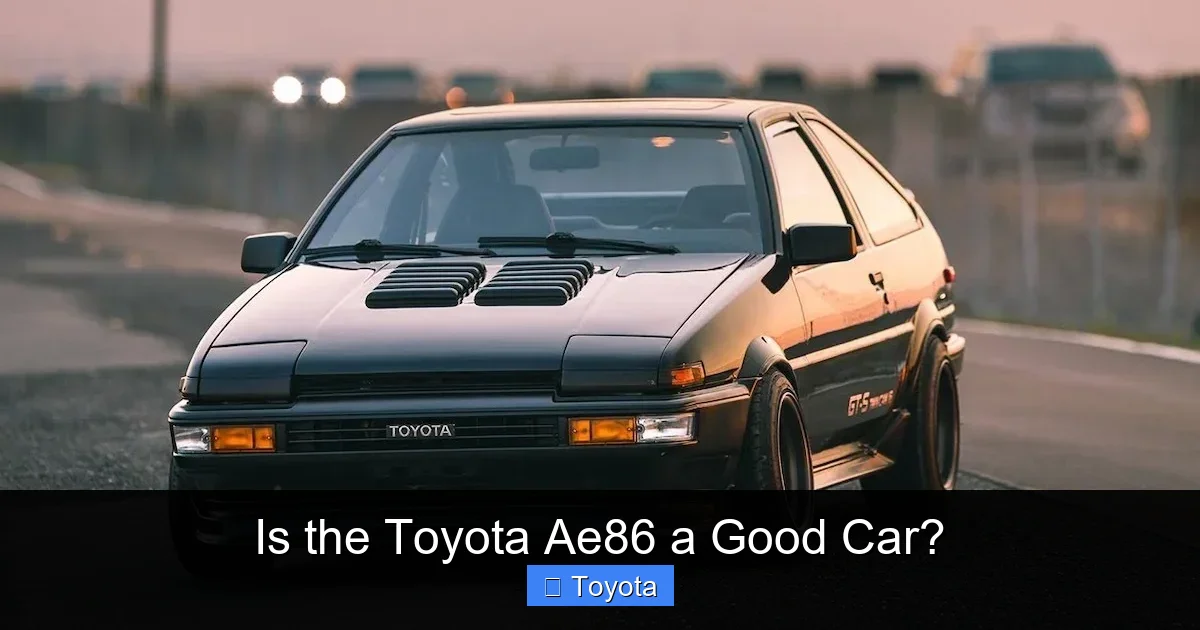
The Toyota AE86 is a good car for enthusiasts who want a lightweight, rear-wheel-drive classic with timeless charm. It’s not practical for families or daily commuters, but it shines on twisty roads and in the garage. If you value driving purity over modern comforts, the AE86 earns its cult status.
If you have spent any time around car culture, you have probably heard the name Toyota AE86. It is the little rear-wheel-drive coupe that became a global icon thanks to anime, manga, and a generation of drifters who proved that you do not need massive horsepower to have fun. But if you are standing in front of a classified ad wondering whether to actually buy one, the real question is simple: is the Toyota AE86 a good car?
The answer depends entirely on what you want from a vehicle. The AE86 is not a comfortable family hauler. It is not packed with modern safety features, and it will not impress anyone with its infotainment system because it does not have one. What it offers is something much rarer today: a pure, mechanical connection between driver and road. For the right person, that makes it a fantastic car. For everyone else, it might be a frustrating purchase.
In this guide, we will look at the Toyota AE86 from every angle. We will cover its history, what it feels like to drive, how reliable it really is, whether it works as a daily driver, and what you should pay for one today. By the end, you will know if this classic Toyota deserves a spot in your garage.
Key Takeaways
- Iconic status: The Toyota AE86 is a legendary rear-wheel-drive coupe from the 1980s, famous for drifting and pop culture.
- Driving fun: Its lightweight chassis and balanced handling make it a joy on back roads and tracks.
- Reliability: Toyota build quality is solid, but age means rust and worn parts are common concerns.
- Daily driving: It lacks space, safety tech, and comfort, so it is best as a second car or weekend toy.
- Market value: Prices have climbed sharply, so clean examples are expensive and often overpriced.
- Best for: Enthusiasts, collectors, and drivers who want a simple, engaging mechanical experience.
📑 Table of Contents
What Is the Toyota AE86?
The Toyota AE86 refers to the fifth-generation Toyota Corolla Levin and Sprinter Trueno, produced from 1983 to 1987. The code AE86 breaks down like this: A for the engine series, E for the Corolla platform, 8 for the fifth generation, and 6 for the specific body variant. It was sold as a two-door coupe or a three-door hatchback, and it came with rear-wheel drive at a time when most Corollas were switching to front-wheel drive.
The AE86 Legacy
The AE86 might have been forgotten as an ordinary economy car if not for a few key factors. First, it was lightweight, tipping the scales at around 2,100 pounds. Second, it had a near-perfect front-to-rear weight balance. Third, it used a live rear axle and a MacPherson strut front suspension that responded beautifully to driver input. These traits made it a natural for motorsport, especially circuit racing and drifting.
Decades later, the Toyota AE86 remains a symbol of the analog driving era. It is celebrated in the manga and anime series Initial D, where the protagonist delivers tofu by day and races mountain passes by night in a black-and-white AE86. That exposure turned the car into a worldwide legend, and prices have followed suit.
Corolla Roots and Rear-Wheel Drive
It is worth remembering that the AE86 is technically a Corolla. It shares its nameplate with one of the best-selling nameplates in automotive history. However, unlike the modern Toyota Corolla you see in driveways everywhere, the AE86 was driver-focused. It came with a four-wheel disc brake option on some models, a limited-slip differential, and a high-revving four-cylinder engine. It was a sporty Corolla in an era when sporty compacts were common.
Driving Experience: Is the Toyota AE86 Fun?
If you ask an AE86 owner why they love the car, the answer almost always comes back to how it feels behind the wheel. The Toyota AE86 does not impress with straight-line speed. It has roughly 112 to 130 horsepower depending on the market and engine tune. That is modest by any standard, especially compared to modern hot hatches.
Lightweight and Nimble
Where the AE86 wins is in its lightness. Because it weighs so little, even modest power feels lively. The steering is unassisted on many models, which means you feel every change in the road surface through your fingertips. The clutch is mechanical, the shifter is short and precise, and the car rotates eagerly when you lift off the throttle in a corner. It rewards smooth driving and punishes sloppy inputs.
On a winding back road, the Toyota AE86 feels like a go-kart with a license plate. It is not fast enough to get you into serious trouble quickly, which means you can explore its limits with relative confidence. That accessibility is a big reason why driving schools and drift events still use AE86s today.
The 4A-GE Engine Sound
Many AE86s came with the 4A-GE, a dual-overhead-cam four-cylinder engine that Toyota developed with input from Yamaha. It is a high-strung little motor that loves to rev. The intake roar and the mechanical clatter of the valvetrain give the car character. It does not sound like a modern turbocharged engine; it sounds like a mechanical instrument, and enthusiasts love that.
Because the engine is naturally aspirated, power delivery is linear. There is no turbo lag to manage, no complex electronics to intervene. You press the pedal, the engine responds, and the car moves. It is simple, honest, and satisfying.
Drifting and Handling
The AE86 gained fame in drifting circles because its rear-wheel-drive layout and relatively narrow tires make it easy to break the rear tires loose. With a limited-slip differential and some seat time, you can slide the car through corners with precision. Even if you never plan to drift, that same chassis balance makes the AE86 feel stable and predictable at the limit.
Reliability: Can You Trust an AE86?
Toyota built the AE86 during a period when the company had a reputation for bulletproof quality. In general, the mechanical components are durable. The engine and transmission can last hundreds of thousands of miles if they were maintained properly. However, the Toyota AE86 is now between 37 and 41 years old. Age introduces problems that no amount of original build quality can prevent.
Common Issues to Watch For
The biggest enemy of any AE86 is rust. These cars were built in Japan and sold in various markets, and many spent their lives in snowy regions where road salt ate through the floor pans, wheel arches, and frame rails. Before buying any AE86, you should inspect the underside thoroughly. Surface rust is common and manageable, but structural rust is expensive and dangerous to fix.
Other common issues include worn suspension bushings, aging rubber hoses, and outdated ignition components. The electrical system is simple by modern standards, but old wiring can become brittle. Interior plastics crack, and headliners sag. None of these are deal-breakers, but they are costs you need to budget for.
Parts and Maintenance Costs
One advantage of owning a Toyota AE86 is that it shares components with other Toyotas of the era. Many mechanical parts are still available through Toyota dealers, aftermarket suppliers, and specialty importers. The enthusiast community is large, so you can find forums, YouTube tutorials, and local clubs to help with repairs.
That said, some AE86-specific body panels and trim pieces are becoming rare and expensive. If you want a car that is cheap to maintain, the AE86 is reasonable—but it is not as cheap as a modern Corolla. You should expect to spend time wrenching or pay a mechanic who is comfortable working on older vehicles.
If you are buying an older Toyota, it is smart to get a professional multi-point inspection before handing over any money. A good inspector can spot leaks, rust, and worn components that you might miss during a test drive.
Is the Toyota AE86 Good for Daily Driving?
This is where the Toyota AE86 struggles. It was never designed to be a comfortable commuter. If your daily routine involves highway traffic, carpooling kids, or hauling groceries, the AE86 will feel like a compromise.
Comfort and Space
The cabin is small. Two adults can sit up front, but the rear seats are best suited for children or luggage. The seats themselves are thin by modern standards, offering little bolstering or lumbar support. Road noise is noticeable, and there is no sound deadening to speak of. Climate control is basic, and many cars lack air conditioning altogether.
Visibility is decent thanks to the upright greenhouse, but the thick A-pillars and small rear window can make parking tricky. If you are tall, you may find the driving position cramped. In short, the AE86 is cozy, not spacious.
Safety Features
Safety is another area where the AE86 shows its age. Depending on the model, you may have front disc brakes and rear drums, or four-wheel disc brakes. There are no airbags, no anti-lock brakes, no traction control, and no stability control. The structure is not designed to modern crash standards. In a serious accident, the AE86 does not offer the protection you would get from a modern car.
For a weekend driver who sticks to low-traffic roads, this is acceptable. For someone who spends hours on busy freeways every day, it is a real concern.
Fuel Economy
On the plus side, the Toyota AE86 is fuel-efficient. The small four-cylinder engine can deliver mid-30s miles per gallon in gentle driving, which is respectable even by today’s standards. It is not going to break the bank at the pump.
Buying a Toyota AE86 Today
The market for the Toyota AE86 has changed dramatically over the last decade. What used to be an affordable enthusiast car is now a collector’s item. Clean, unmodified examples command premium prices, and heavily modified or rusted cars still sell for more than you might expect.
Market Prices
Prices vary widely based on condition, mileage, location, and whether it is a Levin or Trueno, coupe or hatchback. A rough project car might start in the low teens, while a well-maintained, low-mileage example can easily fetch $30,000 to $50,000 or more. Rare trim levels and original paint can push values even higher.
Because values have risen, you will see many overpriced listings. It is important to research recent sales and not fall in love with a car before checking its condition. If a deal seems too good to be true, it usually hides expensive rust or mechanical problems.
What to Look For When Buying
When inspecting an AE86, start with the body. Look for mismatched paint, overspray, and panel gaps that suggest previous accident repairs. Check the floor pans, trunk floor, and frame rails for rust. Start the engine when it is cold; a warm engine can hide starting problems. Listen for knocks, ticks, or excessive smoke from the exhaust.
Test the gearbox and clutch. The shifter should move smoothly into every gear without grinding. The clutch should engage firmly without slipping. Test the brakes for firmness and check that the steering feels tight. If you are not confident in your own assessment, bring a mechanic or use a pre-purchase inspection service.
Alternatives to the Toyota AE86
If the Toyota AE86 sounds appealing but impractical, there are alternatives to consider. Other classic Toyotas from the same era offer similar mechanical simplicity with different body styles. For example, if you are curious about classic Toyota values more broadly, you might look at how much a 1985 Toyota pickup is worth to compare market trends for vintage Toyotas.
Modern Toyotas
If you want reliability and modern safety but still want driving engagement, a used Toyota 86 or Subaru BRZ is the spiritual successor to the AE86. It offers rear-wheel drive, a manual transmission, and a lightweight chassis with airbags, ABS, and a warranty if you buy certified pre-owned. It is not as raw as the AE86, but it is far more livable.
Other Classics
Mazda Miata, Honda Civic EF, and Nissan 240SX are all contemporaries that offer rear-wheel drive or lightweight handling at various price points. The Miata, in particular, is often easier to live with and cheaper to maintain than an AE86.
For routine upkeep on any older Toyota, remember that even simple services matter. Keeping on top of items like a tire rotation at Toyota helps preserve handling and tire life, which is especially important on a lightweight, rear-wheel-drive car like the AE86.
Final Verdict: Is the Toyota AE86 a Good Car?
So, is the Toyota AE86 a good car? The honest answer is yes—but only if it matches your lifestyle and expectations.
If you want a reliable daily driver with space for passengers, modern safety features, and a comfortable ride, the AE86 is not a good choice. It is too small, too basic, and too valuable to expose to daily wear and tear.
If you are an enthusiast who wants a weekend car, a track toy, or a project to restore and enjoy, the Toyota AE86 is excellent. It offers a driving experience that modern cars rarely replicate. It is lightweight, communicative, and deeply satisfying on the right road. It also carries a piece of automotive history that continues to inspire new generations of drivers.
Buy one because you love it, not because you think it is a smart financial investment. Prices may stay strong, but the real value of the AE86 is the smile it puts on your face every time you turn the key.
Frequently Asked Questions
Is the Toyota AE86 reliable?
The Toyota AE86 is generally reliable thanks to its simple engine and strong Toyota build quality. However, because these cars are now decades old, you should expect age-related issues like rust and worn suspension components. Regular maintenance and a thorough inspection are essential before buying.
Can you daily drive a Toyota AE86?
You can daily drive a Toyota AE86, but it is not ideal for most people. It lacks space, comfort, and modern safety features, making it better suited as a second car or weekend driver. If you do use it daily, be prepared for a noisy, cramped, and basic experience.
How much does a Toyota AE86 cost today?
Prices for a Toyota AE86 vary widely depending on condition and location. Project cars can start in the low thousands, while clean, low-mileage examples often sell for $30,000 to $50,000 or more. Rare models and original paint can command even higher prices.
Is the Toyota AE86 good for beginners?
The Toyota AE86 can be a good beginner car for someone interested in learning about driving and car mechanics. Its manual transmission and rear-wheel-drive layout teach fundamental skills, but its age and lack of safety tech mean it requires careful maintenance and cautious driving.
What engine does the Toyota AE86 have?
Most Toyota AE86 models came with the 4A-GE, a 1.6-liter inline-four engine with dual overhead camshafts. Some markets received the less powerful 3A-U engine, but the 4A-GE is the one enthusiasts seek for its high-revving character and tuning potential.
Why is the Toyota AE86 so popular?
The Toyota AE86 is popular because of its lightweight chassis, rear-wheel-drive layout, and balanced handling. It gained worldwide fame through the Initial D anime and manga series, which showcased its drifting abilities. Its simplicity and mechanical feel continue to attract enthusiasts today.