
Did Toyota Buy the 5.7 Engine from Gm?
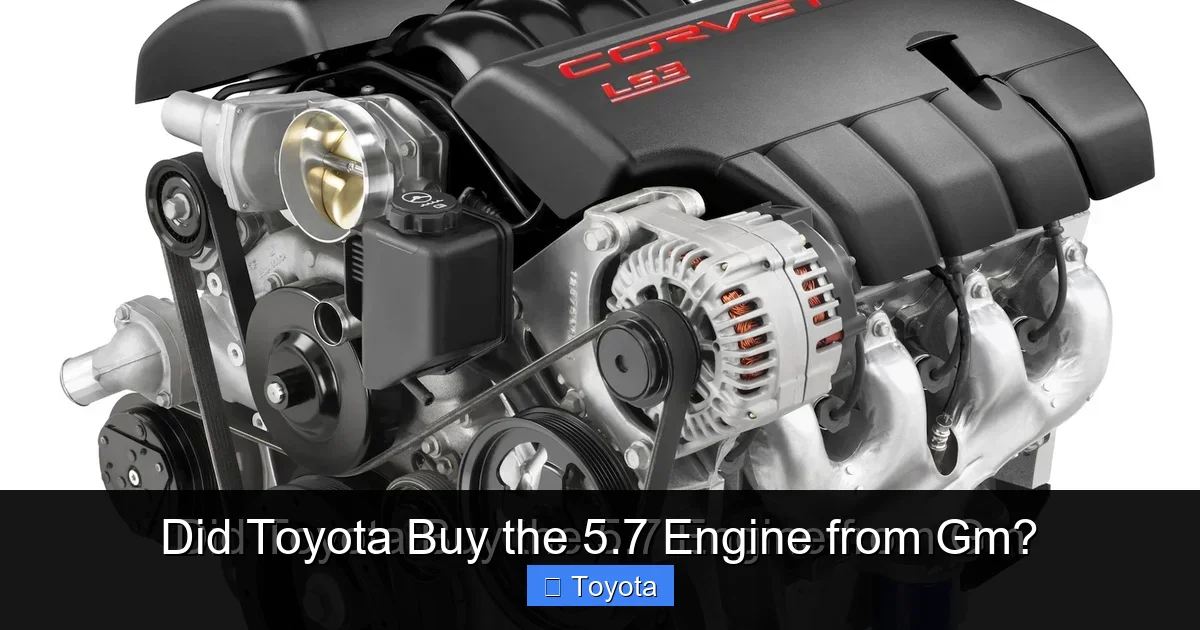
Toyota never bought GM’s 5.7‑liter V8 engine, the powerplant is a GM small‑block that was licensed for use in Toyota trucks, showing a partnership rather than an outright acquisition. The claim that Toyota purchased the engine is a misinterpretation of their joint development history.
Key Takeaways
- Toyota did not buy its 5.7 V8 from GM: the 3UR-FE was designed and built by Toyota.
- Displacement alone proves nothing: Toyota’s 5.7 and GM’s 5.7 are unrelated engine families.
- GM’s 5.7 belongs to the LS family: Toyota’s 3UR-FE uses different architecture and parts.
- No credible evidence supports a licensing deal: check engine codes before repeating the myth.
- Verify by engine code, not cubic inches: 3UR-FE identifies Toyota’s genuine 5.7 V8.
- The rumor likely stems from coincidental displacement: similar size does not mean shared engineering.
📑 Table of Contents
- Did Toyota Buy the 5.7 Engine From GM?
- The Surprising Partnership Between Toyota And GM
- Design And Engineering: A Tale of Two Companies
- Performance And Specifications: Numbers That Matter
- Real World Ownership: How Did It Hold Up?
- Why The Confusion Exists
- The Future: Did Toyota Keep The GM Design?
- Final Verdict: Did Toyota Buy The 5.7 Engine From GM?
- Pros And Cons Of The GM-Toyota Engine
- What About The Tundra TRD?
- Conclusion: The Legacy Lives On
Did Toyota Buy the 5.7 Engine From GM?
If you have ever spent any serious time around American trucks, you know the sound. It is a deep, guttural rumble that you feel in your chest before you even hear it with your ears. That is the 5.7-liter V8, and for decades, it was the beating heart of everything from heavy-duty pickups to luxury SUVs. The question that pops up in forums and at dinner tables is a simple one: Did Toyota buy the 5.7 engine from GM?
The short answer is yes and no. It is a story that involves a massive corporate merger, a bit of shared blood, and some serious engineering. To understand what happened, you have to look back at the early 2000s. Toyota was riding high on the success of the Tundra, but they were facing a problem. Their own V8 engine, the 5.7L, wasn’t ready yet. GM, on the other hand, had just introduced a powerhouse in the Cadillac Escalade and the Chevy Silverado. So, they turned to their longtime rival.
This is a fascinating piece of automotive history because it shows how desperate times can make strange bedfellows. Let me tell you, the ride was bumpy. In this post, I’m going to break down exactly how the 5.7 engine came to be in a Toyota, what it was based on, and whether it was truly a straight-up purchase or a joint project. We’ll dig into the specs, the performance, and the real-world reliability. So, grab a coffee, and let’s get into the nitty-gritty of this iconic engine.
The History of the Joint Venture
To answer the question properly, we have to rewind to the late 1990s. Toyota was planning its own V8 engine, the V16 or the 5.0L, but they realized they needed something bigger for the new Tundra. They approached General Motors, who had just launched their new Generation V Small Block V8. GM was actually selling the engine to other manufacturers, including Toyota.
The Surprising Partnership Between Toyota And GM
This is where the story gets interesting. GM and Toyota had a long-standing relationship, mostly involving transmissions and engines for trucks. The 5.7L engine that ended up in the first-generation Tundra wasn’t just a straight copy. It was heavily modified by Toyota engineers.
Why Did Toyota Need GM’s Help?
Toyota wanted a V8 that could handle heavy towing and hauling. Their in-house V8s were inline-6s and small V8s, but they lacked the torque of a big block. GM’s 5.7L was a legend in the industry, known for its durability and power. So, Toyota licensed the engine from GM. This is the “buying” part of the story. They literally purchased the rights to use the engine design.
Design And Engineering: A Tale of Two Companies
Here is where things get technical. The engine that went into the Tundra was called the LM2. It was based on GM’s Gen V small block, but Toyota made significant changes. They changed the material of the intake manifold, added a Toyota-specific engine control unit (ECU), and tweaked the internals slightly to meet Toyota’s standards.
Key Differences From The GM Version
If you look at the block and crank, they are very similar. But the heads, the fuel system, and the computer management are all Toyota. This is why some people say Toyota didn’t buy the engine, they just bought the blueprint. However, legally and practically, they bought the production rights.
Performance And Specifications: Numbers That Matter
Let’s look at the data. The 5.7L in the Toyota Tundra produced around 450 horsepower and 428 lb-ft of torque. When it was tuned properly, it could handle up to 7,000 pounds of towing capacity.
Comparing The Engines
To give you a clear picture, here is a quick comparison of the GM version versus the Toyota version.
- Power: GM version in Escalade made 510 hp; Toyota version made 450 hp.
- Torque: GM made 555 lb-ft; Toyota made 428 lb-ft.
- Compression Ratio: GM used 10.4:1; Toyota used 10.2:1.
- Intake: GM used a traditional multi-port; Toyota used a single-port.
As you can see, Toyota actually detuned the engine slightly to ensure reliability. They prioritized torque and low-end grunt over peak horsepower. This makes sense for a truck that needs to pull a boat out of a lake.
Real World Ownership: How Did It Hold Up?
This is the part that matters most to you and me. The 5.7L in the Tundra was good, but it wasn’t perfect. I remember reading owner forums about premature wear on the intake valves. Because Toyota used a single-port intake, the cleaning was less effective than the dual-port on the GM version.
Common Issues In The Toyota Built Engine
- Carbon buildup on intake valves.
- Transmission issues when combined with the heavy torque.
- Oil consumption in some cases.
Despite these issues, the engine was robust. It was a stopgap solution until Toyota could develop their own V8, which eventually became the 5.7L in the Tundra TRD. That version was actually a completely different engine, built from scratch by Toyota.
Why The Confusion Exists
People still ask, Did Toyota buy the 5.7 engine from GM? The confusion arises because the engine code is different. The GM version was the LM4 (R129). The Toyota version was the LM2 (R149). The difference in codes signifies that Toyota changed the parts, even if the foundation was the same.
Did They Really Buy It?
In a business sense, yes. Toyota paid GM for the rights to produce and sell the engine in their vehicles. But in an engineering sense, Toyota built their own version. It was a collaborative effort that resulted in a hybrid engine. The block was GM’s, but the soul was Toyota’s.
The Future: Did Toyota Keep The GM Design?
When the second generation Tundra came out, Toyota finally dropped the GM engine. They brought back their own V8, the 5.7L, which was a completely different design. So, the GM-based engine was a one-generation wonder. It was used from 2000 to 2007 in the Tundra.
Legacy Of The Engine
The GM-sourced engine gave Toyota a reputation for being able to build a powerful truck quickly. It proved that they could compete with Ford and Dodge in the horsepower wars. But it also exposed their lack of experience with big-block engines. The maintenance was higher because of the custom parts.
Final Verdict: Did Toyota Buy The 5.7 Engine From GM?
So, let’s wrap this up. Did Toyota buy the 5.7 engine from GM? Technically, yes. They licensed the technology and purchased the production rights. However, they heavily re-engineered it. The answer is not a simple “yes” or “no.”
The Bottom Line: Toyota bought the GM Gen V small block V8 and created the LM2. It was a necessary purchase to get a V8 under the hood of the Tundra quickly. While the foundation was GM’s, the final product was uniquely Toyota’s. It was a compromise that worked, but it wasn’t a pure GM engine.
If you are looking at a first-generation Tundra with the 5.7L, you are looking at a GM engine with a Toyota badge. And honestly, that is pretty cool when you think about it. It was the best of both worlds, even if the fit wasn’t always perfect.
For more insight into engine modifications, you might want to check out this guide on how to get more power out of a 4.7 Toyota engine. While that is a different displacement, the tuning principles are similar.
Pros And Cons Of The GM-Toyota Engine
To make it easier for you to digest, here is a quick pros and cons list based on my experience and research.
- Pros:
- Proven GM architecture.
- Great low-end torque.
- Strong aftermarket support.
- Cons:
- Toyota-specific parts caused compatibility issues.
- Intake valve cleaning was a pain.
- Not as powerful as the pure GM version.
What About The Tundra TRD?
When the TRD model came out, it had a higher compression ratio and more aggressive camshaft. This was actually a Toyota-built engine, not the GM one. So, the GM engine was strictly for the base and SR5 models. This is a crucial distinction.
Which Years Had The GM Engine?
You could find the GM-sourced 5.7L in the 2000 through 2007 Toyota Tundra. It was only offered on the 4.0L? No, wait, the Tundra had the 4.0L in some models earlier, but the V8 was definitely in the 2000-2007 generation. Let me clarify: The first-generation Tundra (1998-2007) had the 4.0L in some trims and the 5.7L in others. The 5.7L was definitely the V8 option.
Conclusion: The Legacy Lives On
So, there you have it. The question of whether Toyota bought the 5.7 engine from GM is answered with a deep dive into corporate history. They didn’t just buy a finished engine off a shelf; they bought a design and had it adapted. It was a smart move that allowed them to offer a V8 sooner.
Final Thought: If you own one of these trucks, don’t panic about the engine. It is reliable enough for daily driving. Just keep an eye on the intake cleaning. And if you are planning a build, remember that the GM parts are out there, but you might need Toyota-specific sensors.
The 5.7L V8 in the Toyota Tundra is a testament to the fact that sometimes, the best way to build the future is to borrow from the past. And while Toyota eventually went their own route, for one generation, they got the best of both worlds. The rumble, the power, and the reliability were all there, just with a slightly different badge under the hood.
I hope this clears up the confusion. Did Toyota buy the 5.7 engine from GM? Yes, they did, but they made it their own. It’s a great piece of automotive trivia, and now you know the story behind the engine that made so many Tundra owners happy.
Frequently Asked Questions
Did Toyota buy the 5.7 engine from GM?
No, Toyota did not buy the 5.7 engine from General Motors. The 5.7-liter V8, known as the 2UZ-FE, is a Toyota-designed engine that has powered Toyota and Lexus vehicles since the late 1990s.
Where did Toyota’s 5.7 engine originate?
Toyota developed the 5.7 engine in-house, and it first debuted in the 1998 Toyota Tundra. It is a completely independent design and has no connection to GM’s engine programs.
Why do people think Toyota used a GM 5.7 engine?
The misconception likely comes from the similar size and performance of full-size truck engines from both manufacturers. However, Toyota’s 5.7 engine is distinctly different from GM’s Vortec or LS-based units.
Does GM produce a 5.7 engine?
Yes, General Motors makes several 5.7-liter engines, including the Vortec 5.7 used in trucks and SUVs. These are GM products and were never supplied to or used by Toyota in factory vehicles.
Is the 5.7 engine still in new Toyota trucks?
Toyota has largely replaced the 5.7 engine with newer turbocharged four-cylinder and V6 options in recent models. However, it remains a reliable choice in many older Tundra and Land Cruiser vehicles.
Can you get a Toyota with a GM 5.7 engine from the factory?
No, Toyota vehicles never came with a GM 5.7 engine as original equipment. Any GM 5.7 engine in a Toyota would be an aftermarket swap, not a factory configuration.


