How Many Toyota Supras Were Made?
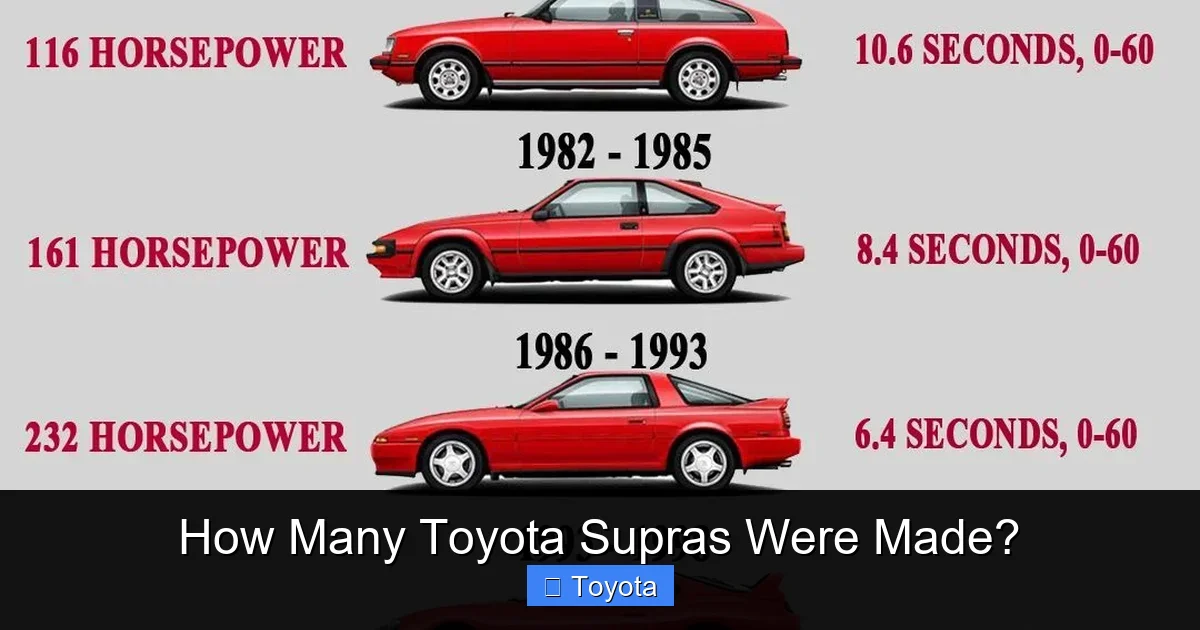
Toyota has produced approximately 1.1 million Supras across five generations since 1978. The fourth generation (A80) remains the most iconic with around 114,000 units, while the current fifth generation continues adding to the total each year.
When you ask how many Toyota Supras were made, you’re really asking about one of the most storied nameplates in automotive history. The Supra has evolved from a Celica trim level into a standalone icon that spans over four decades. Whether you’re a collector hunting for a rare find or an enthusiast curious about production totals, understanding the numbers behind each generation helps you appreciate what makes certain models so special.
Toyota has built approximately 1.1 million Supras total since the nameplate debuted in 1978. That number surprises many people who assume the Supra was always a low-volume halo car. In reality, the first three generations sold in strong numbers as grand tourers, while the fourth generation’s legend grew despite modest production. The current fifth generation continues that legacy with modern engineering and BMW collaboration.
Key Takeaways
- Total Production: Roughly 1.1 million Supras built across all five generations since 1978.
- First Generation (1978-1981): Approximately 130,000 units produced as the Celica Supra.
- Second Generation (1982-1986): Around 200,000 units made with distinct styling and turbo option.
- Third Generation (1986-1992): Nearly 300,000 units built, introducing the 7M-GE and 7M-GTE engines.
- Fourth Generation (1993-2002): About 114,000 units produced, becoming a legend with the 2JZ engine.
- Fifth Generation (2019-Present): Over 50,000 units and counting, developed with BMW partnership.
- Rarity Matters: Low-volume special editions and early models command highest collector values today.
📑 Table of Contents
- First Generation Production: 1978-1981 Celica Supra
- Second Generation Production: 1982-1986 A60 Chassis
- Third Generation Production: 1986-1992 A70 Chassis
- Fourth Generation Production: 1993-2002 A80 Chassis
- Fifth Generation Production: 2019-Present A90/J29 Chassis
- Factors That Influence Production Numbers
- Collectibility and Survival Rates
- How to Verify Production Numbers for a Specific Supra
- Future Production Outlook
- Conclusion
First Generation Production: 1978-1981 Celica Supra
The Supra story begins with the A40/A50 chassis, marketed as the Celica Supra in most markets. Toyota produced roughly 130,000 units during this four-year run. These cars shared the Celica platform but featured a longer wheelbase and inline-six engines borrowed from the Crown sedan.
Year-by-Year Breakdown
Production started slowly in 1978 with about 15,000 units for the Japanese market. The 1979 model year saw expansion to North America, pushing annual output to around 35,000. Peak production hit 45,000 in 1980 before tapering to 35,000 in the final 1981 model year as the second generation loomed.
Key Variants and Rarity
The early MA45 chassis with the 2.6L 4M-E engine are the most common. The MA46/MA47 models with the 2.8L 5M-E arrived in 1979. The rarest first-gen Supra? The 1981 “Performance Package” cars with limited-slip differential and upgraded suspension – fewer than 2,000 built.
Second Generation Production: 1982-1986 A60 Chassis
The A60 generation marked the Supra’s visual coming-of-age with pop-up headlights and wedge styling. Toyota built approximately 200,000 units across five model years. This generation introduced the turbocharged 7M-GTE engine in 1986, creating instant collector interest.
Market Distribution
North America absorbed roughly 60% of production, with Japan taking 25% and the rest going to Europe, Australia, and other markets. The 1986 model year saw a production spike to 55,000 units as buyers rushed for the new turbo model before the third generation arrived.
Turbo vs. Naturally Aspirated Numbers
Of the 200,000 total, only about 15,000 were factory turbo models (MA70). The naturally aspirated 5M-GE cars dominate the population. This 7.5% turbo ratio makes any surviving A60 Turbo a genuine rarity, especially in original condition.
Third Generation Production: 1986-1992 A70 Chassis
The A70 generation represents peak Supra production volume with nearly 300,000 units built. This generation lasted six years and saw major engineering upgrades, including the switch to the 7M-GE/7M-GTE engine family in 1986.5 and the introduction of the 1JZ-GTE in Japan.
The 7M Engine Transition
Early 1986 models (often called 1986.5) used the carryover 5M-GE. The 7M-GE debuted mid-year, with the 7M-GTE turbo following for 1987. Toyota built roughly 45,000 units annually during peak years 1987-1989. The 1992 final year saw only 12,000 units as the A80 launch approached.
Japanese Market Exclusives
Japan received the 1JZ-GTE twin-turbo 2.5L engine in the JZA70 model starting in 1990. Only about 8,000 of these were produced, making them highly sought after by importers today. The A70 also spawned the rare Aerotop targa roof variant – roughly 3,000 units total.
Fourth Generation Production: 1993-2002 A80 Chassis
The legendary A80 Supra saw production of approximately 114,000 units worldwide. Despite its outsized reputation, this was actually the lowest-volume generation until the current model. The 2JZ-GTE engine, Getrag V160 transmission, and timeless design created a perfect storm of desirability.
US Market Numbers
America received about 11,000 units total from 1993-1998. The 1993 launch year saw 3,800 units, peaking at 4,500 in 1994 before declining sharply. Only 1997-1998 models got OBD-II compliance updates. The 1998 model year had just 1,200 units, making it the rarest US-spec A80.
Japan and Export Figures
Japan kept the A80 in production until 2002, accounting for roughly 70,000 units. European markets received about 15,000 units with different emissions equipment. The remaining units went to Australia, South Africa, and other right-hand-drive markets. Turbo models comprised about 60% of Japanese production but only 30% of US deliveries.
Fifth Generation Production: 2019-Present A90/J29 Chassis
The current GR Supra has already surpassed 50,000 units globally since its 2019 debut. Developed alongside the BMW Z4 at Magna Steyr in Austria, this generation uses BMW B58 engines and ZF transmissions. Annual production runs around 10,000-12,000 units depending on demand.
Launch Edition and Special Models
The 2020 Launch Edition was limited to 1,500 units globally with unique badging and carbon fiber mirrors. The 2021 GR Supra 3.0 Premium added the manual transmission option in 2023, creating a new collector variant. The 2023 45th Anniversary Edition capped at 900 units worldwide.
Manual Transmission Take Rate
Since the manual’s introduction in 2023, take rates have hovered around 15% in North America. That means roughly 1,500 manual Supras per year – a tiny number that guarantees future collectibility. The automatic remains dominant for track performance, but the manual appeals to purists.
Factors That Influence Production Numbers
Several forces shape how many Supras Toyota builds each generation. Understanding these helps explain why some years are abundant while others are scarce.
Economic Conditions
The early 1990s Japanese asset bubble burst crushed A80 sales in Japan. The 2008 financial crisis would have killed the Supra entirely if not for the BMW partnership years later. Strong economies correlate with higher sports car production across all generations.
Regulatory Pressures
Emissions standards forced the A80 out of the US after 1998. The current generation barely meets modern regulations with its BMW-sourced engine. Each generation faces stricter rules that limit engineering options and increase per-unit costs.
Platform Sharing Decisions
The first three generations shared Celica underpinnings, keeping costs low and volumes high. The A80 used a dedicated platform, driving up costs. The A90 returns to platform sharing with BMW, enabling viable production volumes at lower cost.
Market Positioning Shifts
Early Supras were grand tourers competing with Nissan Z-cars and Mazda RX-7s. The A80 moved upmarket to challenge Porsche 911s and Corvettes. The A90 targets the Cayman/Boxster segment. Each repositioning changes the potential buyer pool and production targets.
Collectibility and Survival Rates
Production numbers only tell half the story. Survival rates determine how many Supras actually exist today.
The Attrition Factor
First and second generation Supras suffer from rust and neglect. Experts estimate fewer than 10% of A40/A50 and A60 models survive in running condition. The A70 fares slightly better at 15% due to newer age. The A80 enjoys a 60%+ survival rate thanks to immediate collector status.
Modification Impact
The tuning culture surrounding Supras, especially A80 and A90 models, means many “survivors” are heavily modified. Finding a bone-stock, unmolested example becomes harder each year. This effectively reduces the collectible population below raw survival numbers.
Export and Gray Market Effects
Japanese domestic market Supras flow worldwide through export channels. This redistributes population away from Japan but doesn’t change global totals. However, it creates regional concentrations that affect local market prices and availability.
How to Verify Production Numbers for a Specific Supra
If you’re researching a particular car, several resources can confirm its place in the production sequence.
VIN Decoding Basics
Every Supra VIN contains production sequence information. The last six digits typically represent the sequential build number. For A80 models, the VIN plate on the dashboard and door jamb sticker both show this. Online VIN decoders can extract model year, plant, and sequence data.
Factory Documentation
Japanese-market Supras often retain “export certificates” showing original registration date and prefecture. US models have Monroney window stickers (if preserved) showing exact options and port of entry. Toyota’s historical services can sometimes provide build records for a fee.
Registry Communities
Enthusiast registries like the Supra Club of America and various Facebook groups maintain member databases. While not official, these crowdsourced lists often capture 20-30% of surviving examples and can verify rare option combinations.
Future Production Outlook
The Supra’s future production depends on several evolving factors.
Electrification Pressures
Toyota has confirmed a fully electric GR sports car in development. Whether it carries the Supra name remains unknown. Current A90 production will likely continue through 2025-2026 before a transition. Hybrid variants could extend the internal combustion timeline.
BMW Partnership Continuation
The Magna Steyr contract runs through the current generation. A next-generation Supra could stay with BMW, switch to a Toyota platform, or go solo electric. Each path implies different volume targets and cost structures.
Market Demand Signals
Current A90 sales run 10,000-12,000 annually – healthy for a niche sports car but far below 1980s peaks. Toyota seems content with this volume as a brand halo vehicle. Significant increases would require price reductions that might dilute the GR premium positioning.
Conclusion
So how many Toyota Supras were made? The answer spans 1.1 million units across five distinct generations, each reflecting its era’s technology, economics, and automotive culture. From the humble Celica Supra’s 130,000 units to the legendary A80’s 114,000 and the modern GR Supra’s growing tally, every generation tells a different story.
What makes this nameplate special isn’t just the totals – it’s the survival rates, the cultural impact, and the engineering milestones each generation represents. Whether you own a pristine 1985 P-Type, a modified 1994 Twin Turbo, or a brand-new 3.0 Manual, you’re part of a lineage that balances volume accessibility with genuine enthusiast credibility. The next time someone asks about Supra production numbers, you’ll know the real story behind the statistics.
Frequently Asked Questions
How many Toyota Supras were made in total?
Approximately 1.1 million Toyota Supras have been produced across all five generations from 1978 through present day. This includes roughly 130,000 first generation, 200,000 second generation, 300,000 third generation, 114,000 fourth generation, and over 50,000 fifth generation units.
Which Supra generation had the highest production numbers?
The third generation (A70, 1986-1992) holds the record with nearly 300,000 units produced. It benefited from a six-year model run, shared Celica platform costs, and strong global demand for Japanese grand tourers during the late 1980s economic boom.
How many fourth generation Supras (A80) were sold in the US?
Only about 11,000 A80 Supras were sold in the United States from 1993-1998. The 1993 launch year saw 3,800 units, peaking at 4,500 in 1994, then declining to just 1,200 units in the final 1998 model year.
Are fifth generation Supras still being produced?
Yes, the fifth generation GR Supra (A90/J29) remains in active production since its 2019 launch. Current annual output runs approximately 10,000-12,000 units globally, with production occurring at the Magna Steyr facility in Graz, Austria alongside the BMW Z4.
What is the rarest production Supra model?
The 1998 US-spec A80 Turbo with the 6-speed manual transmission is among the rarest regular production models at roughly 300 units. Even rarer are the 1981 first-gen Performance Package cars (under 2,000) and the Japan-only JZA70 1JZ-GTE models (about 8,000).
How can I find the production number for my specific Supra?
Check the last six digits of your VIN for the sequential build number. For A80 models, the driver’s door jamb sticker and dashboard VIN plate both display this. Online VIN decoders and Toyota historical services can provide additional build details including exact production date and original specifications.