
Is a Toyota Tundra a 3/4-ton Truck?
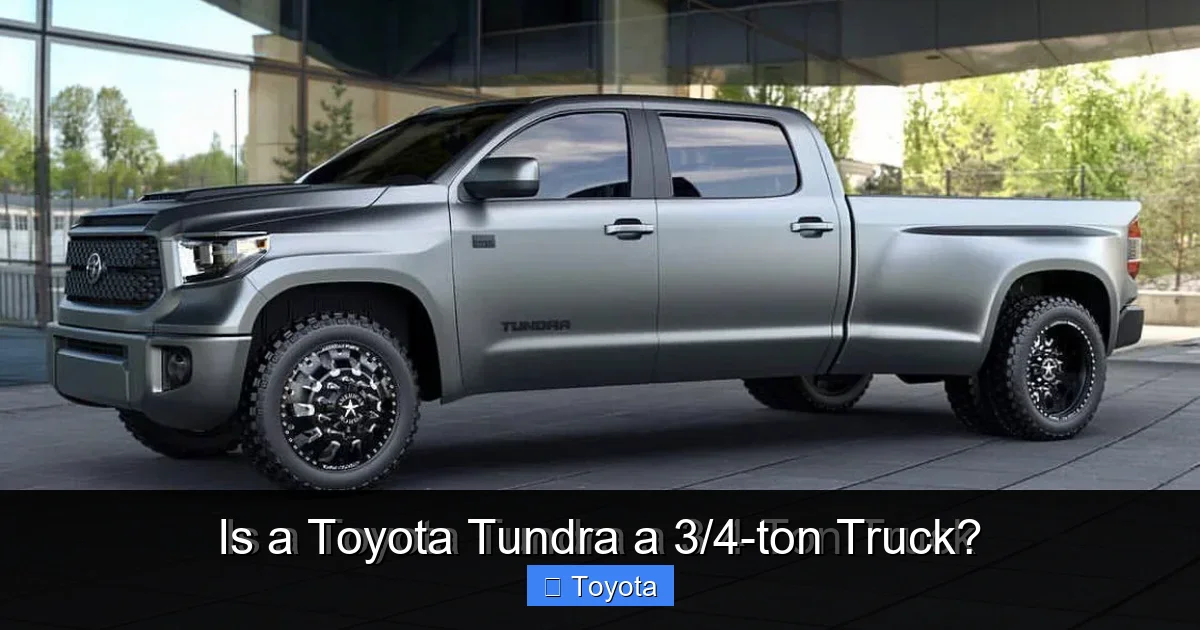
No, a Toyota Tundra is not a 3/4-ton truck. It’s a full-size half-ton pickup, and it has been since it launched in 2000. Its payload and towing numbers land right in line with other half-tons like the F-150 and Silverado 1500—well short of the heavy-duty 3/4-ton class. The “3/4-ton” label is a leftover from an old rating system, not a literal weight.
Here’s a question that pops up in truck forums, dealerships, and campgrounds all the time: is a Toyota Tundra a 3/4-ton truck? It sounds simple enough. But the answer gets tangled up in old terminology, marketing language, and a whole lot of confusion about what those “half-ton” and “3/4-ton” labels even mean anymore.
Let’s clear it up right away. No, the Toyota Tundra is not a 3/4-ton truck. It’s a full-size half-ton pickup. That’s been true since the first Tundra rolled off the line in 2000, and it’s still true with the current third-generation truck.
But the “why” is more interesting than the “no.” Once you understand where these truck classes came from and how they’re measured today, you’ll know exactly what the Tundra can and can’t do. You’ll also know whether you actually need a heavy-duty truck or if a Tundra will handle your weekend projects just fine. Let’s dig in.
Key Takeaways
- The Tundra is a half-ton truck: Every generation, from 2000 to today, has been classified as a full-size half-ton pickup.
- “3/4-ton” is an old label: The term comes from a mid-1900s payload rating system and no longer describes actual capacity.
- Payload tells the real story: The Tundra’s payload tops out around 1,940 pounds, while true 3/4-ton trucks often handle 3,000 to 4,000+ pounds.
- Towing is close but not equal: The Tundra maxes out near 12,000 pounds. Heavy-duty 3/4-ton trucks can pull well over 18,000 pounds.
- Size isn’t class: The Tundra looks big and aggressive, but looks don’t change its GVWR rating or its legal load limits.
- Check your door jamb sticker: Your specific truck’s payload and GVWR are printed right there—that’s the number that actually matters.
- Buy for the job, not the label: If you need to haul a heavy slide-in camper or a big fifth wheel, you need a real 3/4-ton truck.
📑 Table of Contents
What Does “3/4-Ton” Actually Mean?
First things first: a “3/4-ton” truck does not carry 1,500 pounds. A “half-ton” doesn’t carry 1,000 pounds either. Those numbers are historical leftovers, and they’ve been out of date for decades.
Where the Labels Came From
Back in the 1940s and 1950s, truck makers rated their vehicles by payload capacity in tons. A half-ton truck could haul about 1,000 pounds. A 3/4-ton could haul about 1,500 pounds. A one-ton could haul 2,000 pounds.
Those numbers made sense at the time. Trucks were simple, small, and built for work. But as frames got stronger and engines got more powerful, payload capacities ballooned. The labels stuck around anyway, mostly because buyers and dealers got used to them.
What the Labels Mean Today
In modern terms, here’s how the classes break down:
- Half-ton (Class 2): Full-size light-duty trucks like the Tundra, F-150, Silverado 1500, and Ram 1500. Payload usually ranges from about 1,300 to 2,500 pounds.
- 3/4-ton (Class 2b/3): Heavy-duty trucks like the F-250, Silverado 2500, and Ram 2500. Payload often runs from 3,000 to 4,500 pounds.
- One-ton (Class 3): Trucks like the F-350, Silverado 3500, and Ram 3500. Payload can exceed 7,000 pounds in some configurations.
So when someone asks if a Toyota Tundra is a 3/4-ton truck, they’re really asking whether it belongs in that heavy-duty group. It doesn’t. It sits firmly in the half-ton class.
The Tundra’s Real Numbers
Labels are one thing. Numbers are another. Let’s look at what the current Tundra can actually do.
Payload Capacity
The current-generation Tundra has a maximum payload of roughly 1,940 pounds in its most capable configuration. That’s a solid figure for a half-ton truck. It’s competitive with the F-150 and Silverado 1500.
But notice something important: that’s the maximum, and it only applies to specific cab, bed, and trim combinations. Load up a fully optioned CrewMax Capstone with a sunroof and premium audio, and your real payload might drop to around 1,300 pounds. That’s a big difference.
Towing Capacity
The Tundra’s maximum tow rating sits at about 12,000 pounds when properly equipped. Again, that’s respectable for a half-ton. It’s enough for most travel trailers, utility trailers, and smaller boats.
But true 3/4-ton trucks routinely tow 18,000 to 20,000 pounds. That’s a completely different league. If you’re pulling a 15,000-pound fifth wheel toy hauler, the Tundra simply isn’t the tool for the job.
Weight and GVWR
Gross vehicle weight rating, or GVWR, is the total weight your truck can safely carry—truck, passengers, cargo, and tongue weight combined. The Tundra’s GVWR lands in the 7,000 to 7,700-pound range depending on the model.
Heavy-duty 3/4-ton trucks typically start around 10,000 pounds GVWR and go up from there. That gap is the clearest dividing line between the classes. If you want to know more about the Tundra’s curb weight and how it factors into all this, check out how much a Toyota Tundra weighs across different configurations.
Tundra vs. True 3/4-Ton Trucks
Numbers aside, there are physical differences that separate these trucks. Here’s what you’d notice if you parked a Tundra next to an F-250.
Frame and Axles
Heavy-duty trucks use thicker, fully boxed frames and beefier axles. The Tundra uses a strong frame too, but it’s built for light-duty loads. Its axles and wheel bearings are sized accordingly.
Brakes and Suspension
Three-quarter-ton trucks come with larger brake rotors, heavier springs, and stiffer shocks. They’re designed to stay stable with 3,000 pounds in the bed. The Tundra’s suspension is tuned for comfort and everyday driving, which is exactly what most half-ton buyers want.
Engine Options
Heavy-duty trucks offer big gas V8s and turbo-diesels built for sustained heavy work. The Tundra offers a twin-turbo V6 and a hybrid version of that same engine. Both are strong and smooth, but they’re tuned for efficiency and daily drivability rather than constant max-load towing.
Cooling and Durability Under Load
This is the part people overlook. A 3/4-ton truck has extra transmission cooling, larger radiators, and heavier-duty differentials. Those parts matter when you’re pulling 12,000 pounds up a mountain pass every weekend for five years. The Tundra can handle occasional heavy loads, but it isn’t engineered for that kind of repeated abuse.
Why People Think the Tundra Is a 3/4-Ton
So why does this question come up so often? A few reasons.
It Looks Massive
The current Tundra is a big, blocky, aggressive-looking truck. Park it next to an older F-250 and it might not look much smaller. But visual size and weight class are two different things. A truck’s class is defined by its GVWR, not its sheet metal.
High-End Trims Feel Heavy-Duty
Trims like the 1794 Edition and the Capstone come loaded with leather, real wood, and premium tech. They feel like luxury heavy-duty trucks inside. But all that luxury actually reduces payload, because those features add weight to the truck itself.
Half-Ton Trucks Keep Getting Bigger
Modern half-tons are bigger and more capable than ever. Twenty years ago, a half-ton towing 12,000 pounds would have been unheard of. Today it’s normal. That blurring of the lines makes the old labels feel less useful—which is exactly why so many people get confused.
What the Tundra Is Actually Great At
None of this means the Tundra is a weak truck. It just means it’s built for a different job. Here’s where it shines.
Family Duty and Daily Driving
The Tundra rides well, parks reasonably, and fits in a standard garage in most configurations. It’s comfortable on long highway trips and easy to live with on a daily basis. Heavy-duty trucks are none of those things.
Weekend Projects
Hauling mulch, moving furniture, towing a small boat, or pulling a utility trailer? The Tundra handles all of it without breaking a sweat. For the vast majority of truck owners, this is 95% of what they’ll ever do.
Travel Trailers
A Tundra is a genuinely great match for a mid-size travel trailer in the 6,000 to 8,000-pound range. Plenty of people full-time in that setup. Just watch your payload—tongue weight eats into it fast, and so do passengers and gear.
Fifth Wheels? Be Careful
This is where people get into trouble. Most fifth wheel trailers are too heavy for a half-ton truck once you factor in pin weight. If you’re considering it, read up on whether a Toyota Tundra can pull a fifth wheel before you sign any paperwork.
How to Figure Out What Truck Class You Need
Forget the labels for a minute. Here’s a practical way to decide.
Step 1: Add Up Your Real Load
Write down the weight of everything that goes in or on the truck: passengers, tools, coolers, firewood, camper shell, and trailer tongue weight. Be honest. Most people underestimate by a few hundred pounds.
Step 2: Check the Door Jamb Sticker
Open the driver’s door and find the yellow-and-white sticker. It lists your specific truck’s payload capacity and GVWR. This is the number that matters—not the brochure, not the commercial, not what the salesperson said.
Step 3: Compare
If your real load is comfortably under the sticker number, you’re fine with a half-ton. If you’re at or over it, you need a heavier truck. It’s that simple.
Step 4: Think About Frequency
Are you maxing out once a year or every single weekend? Occasional heavy loads are one thing. Constant heavy loads are another. Repeatedly running a half-ton at its limit will wear it out faster than a heavy-duty truck would.
The Bottom Line
A Toyota Tundra is a half-ton truck. It always has been, and there’s no sign that’s changing. It’s a capable, comfortable, well-built full-size pickup that handles the vast majority of real-world truck jobs with ease.
But if you need to haul a truck camper, pull a big fifth wheel, or tow heavy equipment day after day, a 3/4-ton truck from Ford, Chevy, Ram, or GMC is the right call. Those trucks are built with thicker frames, bigger brakes, and cooling systems designed for sustained heavy work.
The good news? You don’t have to guess. Your door jamb sticker tells you exactly what your truck can carry. Do the math on your real load, compare it to that number, and you’ll know instantly whether a Tundra fits your life—or whether you need to step up to the heavy-duty class.
Frequently Asked Questions
Is a Toyota Tundra considered a 3/4-ton truck?
No. The Toyota Tundra is classified as a full-size half-ton pickup. It competes with the Ford F-150, Chevrolet Silverado 1500, and Ram 1500, not with heavy-duty 3/4-ton trucks like the F-250 or Silverado 2500.
What is the difference between a half-ton and a 3/4-ton truck?
The main difference is payload, towing, and GVWR. Half-ton trucks typically carry 1,300 to 2,500 pounds and tow up to around 13,000 pounds. Three-quarter-ton trucks usually carry 3,000 to 4,500 pounds and can tow well over 18,000 pounds when properly equipped.
How much can a Toyota Tundra actually haul?
The current Tundra has a maximum payload of roughly 1,940 pounds in its most capable configuration. Real-world payload drops once you add options, passengers, and gear, so always check the sticker on your specific truck’s door jamb.
Can a Toyota Tundra tow a fifth wheel trailer?
It’s possible with very small, lightweight fifth wheels, but most fifth wheel trailers exceed the Tundra’s payload and pin weight limits. Always calculate pin weight plus passengers and cargo against your truck’s rated payload before towing.
Why do people call the Tundra a 3/4-ton truck?
Mostly because of its size and presence. The current Tundra is large and aggressive-looking, and high-end trims feel luxurious and heavy-duty. But visual size doesn’t change a truck’s GVWR classification, which is what actually defines its class.
Should I buy a Tundra or a 3/4-ton truck?
If you tow a mid-size travel trailer, haul occasional loads, and use your truck as a daily driver, a Tundra is a great choice. If you regularly tow heavy trailers, carry a slide-in camper, or need maximum payload, step up to a true 3/4-ton heavy-duty truck.


