Is Toyota Prepaid Maintenance Worth It?
Toyota prepaid maintenance plans can lock in current service prices, but are they really a smart buy? We weigh the costs, coverage, and who actually benefits to help you decide if the investment fits your driving habits and budget.
Buying a new Toyota often comes with tempting offers, and one of the most talked-about is the prepaid maintenance plan. You’ve seen it on the window sticker: a lump sum paid upfront that promises to cover your scheduled service for a set period or mileage. But when you’re standing in the finance office, the question hits hard: is Toyota prepaid maintenance worth it? In this deep dive, we’ll explore the real costs, what’s actually covered, and whether this plan aligns with your driving habits. We’ll keep things simple, conversational, and grounded in facts so you can walk away confident in your choice.
Toyota’s prepaid maintenance plans are designed to give peace of mind by fixing service prices at the time of purchase. The idea is straightforward: you pay a one-time fee upfront, and the plan covers all recommended maintenance items outlined in your owner’s manual for a specific term—often 2 years or 25,000 miles, though longer options exist. On the surface, it sounds like a no-brainer. But like any financial product, the devil is in the details. Let’s pull back the curtain and see if this plan earns a spot in your budget or if you’re better off sticking with pay-per-service.
Key Takeaways
- Point 1: Prepaid maintenance locks in labor and parts rates at today’s prices, protecting you from future inflation at the dealership.
- Point 2: The plan typically covers routine services like oil changes, tire rotations, and multi-point inspections according to your vehicle’s scheduled maintenance booklet.
- Point 3: If you keep your Toyota for many years or drive high mileage, the plan often pays for itself compared to paying per service.
- Point 4: Transferability is a valuable perk; if you sell your vehicle, the remaining prepaid maintenance can often be transferred to the new owner, adding resale appeal.
- Point 5: Not every service is covered; wear items like brake pads, wiper blades, and batteries are usually excluded, so read the fine print carefully.
- Point 6: You must use authorized Toyota dealerships for the plan to honor coverage, limiting your choice of independent mechanics.
- Point 7: For low-mileage owners who rarely follow the severe service schedule, paying as you go may be more cost-effective upfront.
📑 Table of Contents
What exactly does the plan cover?
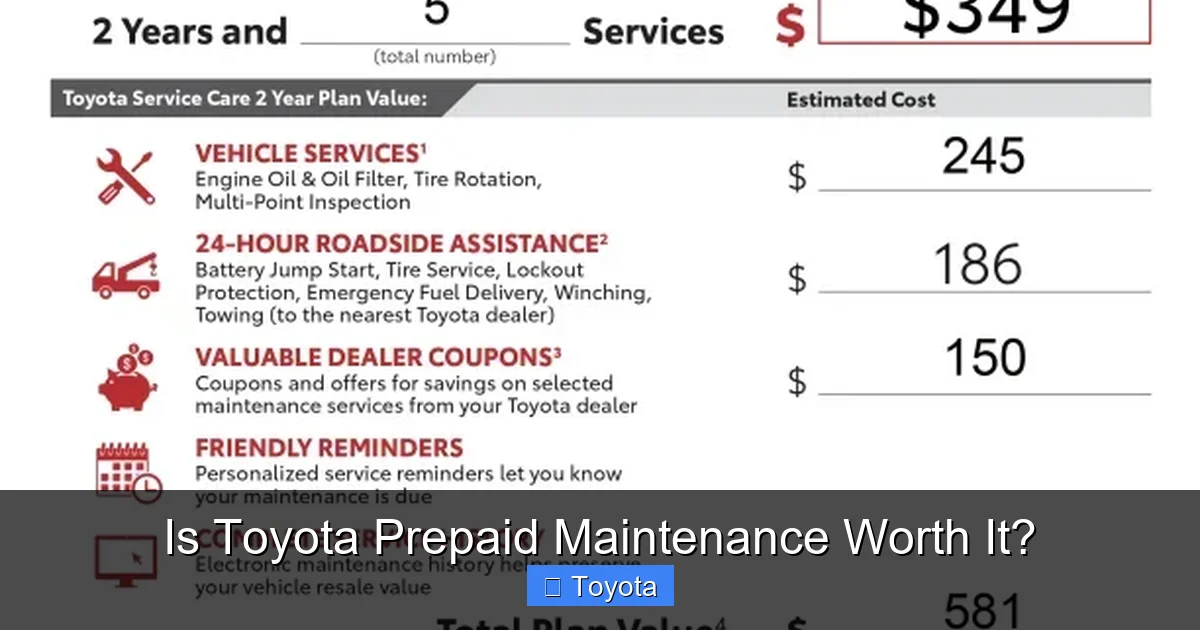
Toyota’s prepaid maintenance menu is tied to the factory scheduled maintenance booklet. That means it typically covers the nitty-gritty services that keep your engine running smoothly and your vehicle safe. Think oil and filter changes, tire rotations, brake fluid replacement, and multi-point inspections. Some plans also throw in things like engine air filter replacement and cabin air filter changes. The goal is to handle the routine stuff that every Toyota owner eventually faces.
However, it’s crucial to note what’s not covered. Wear items—those parts that naturally degrade through normal use—are almost always excluded. Brake pads, rotors, wiper blades, and batteries fall into this category. Additionally, any repairs needed due to accidents, misuse, or missed maintenance intervals will void the plan’s coverage. If you’re the type of owner who meticulously follows every service reminder, the plan can be a great match. If you’re more relaxed about maintenance intervals, you might find yourself paying for coverage you never fully use.
Cost comparison: prepaid vs. pay-per-service
Let’s talk numbers. A typical Toyota prepaid maintenance plan for a 2-year/25,000-mile term might run between $500 and $1,200 depending on the model and trim. At first glance, that seems like a lot. But break it down: a single oil change at a Toyota dealership can cost $50 to $100, a tire rotation $30 to $50, and a multi-point inspection often runs $100 or more if performed a la carte. If you service your Toyota twice a year, you’re looking at $300 to $600 annually just on routine items. Over two years, the prepaid plan could easily undercut those costs, especially when you factor in labor rate increases.
On the flip side, if you’re a low-mileage driver who only services the vehicle once a year or less, the upfront payment might not make financial sense. You’d be paying for coverage that sits unused. The sweet spot for prepaid maintenance is the moderate-to-high mileage driver who follows the service schedule religiously and keeps the vehicle for the long haul. In those scenarios, the plan often pays for itself within the first couple of service visits.
Pros and cons at a glance
Every financial decision has trade-offs. Here’s how the scales tip for Toyota prepaid maintenance:
- Pros: Price protection against rising dealership labor rates, predictable budgeting, transferability to future owners, and the convenience of having one less thing to remember or pay for at each service visit. You also avoid the surprise of a $400 service bill when you’re already tight on cash.
- Cons: Upfront cost that may not be recouped if you sell or trade the vehicle early, restricted use to Toyota dealerships only, and exclusions for wear items. If you’re the kind of owner who likes to shop around for independent mechanics or perform DIY maintenance, this plan won’t align with your habits.
Who should (and shouldn’t) buy it?
Consider the prepaid plan if you plan to keep your Toyota for at least three to five years, drive above the average annual mileage (think 15,000+ miles per year), and appreciate the peace of mind that comes with knowing exactly what your maintenance costs will be. It’s also a solid choice for families who rely on their vehicle daily and want to avoid unexpected service expenses during tight budget months.
On the other hand, skip the plan if you’re the type of owner who trades vehicles every two years, keeps mileage well below the severe-service threshold, or enjoys wrenching on your own car in the garage. For you, paying per service—or even joining a local independent shop’s maintenance club—might save money and give more flexibility.
Real-world example: making the math work
Imagine you own a 2023 Toyota Camry LE, and you drive about 18,000 miles per year. Over a three-year ownership span, Toyota’s scheduled maintenance calls for six oil changes, six tire rotations, and six multi-point inspections. If you pay out-of-pocket at current dealership rates, you might spend roughly $1,800 on those services alone, not including any unexpected items like air filter replacements. A three-year prepaid maintenance plan for a Camry could cost around $900 upfront. In this scenario, you’re breaking even around the second service visit, and by year three, you’ve saved nearly a grand. Add in the convenience factor, and the plan becomes an even more attractive proposition.
Now picture a different situation: you have a 2021 Toyota Corolla that you drive only 6,000 miles a year, mostly for short commutes. You service it once a year, and you’re diligent about checking fluids and tire pressure yourself. In this case, a prepaid plan might cost you $600 upfront for services you’ll only use $150 worth of annually. Here, the math doesn’t favor the plan, and you’d be better off putting that $600 into a high-yield savings account earmarked for future car expenses.
Tips for getting the most out of your plan
If you decide the prepaid maintenance plan is right for you, a few practical steps can help you maximize its value. First, mark your calendar. Know exactly when each service is due and schedule it promptly at an authorized Toyota dealership. The plan won’t cover missed or late services, and you don’t want to forfeit coverage because you forgot the deadline. Second, keep every service receipt and work order. Documentation proves the work was done according to the plan’s terms and can be crucial if you ever need to transfer the plan to a new owner.
Third, familiarize yourself with the exclusion list. Know what’s not covered so you can budget separately for brake pads, wiper blades, and other wear items. Fourth, if you’re selling your Toyota privately, ask the dealer about transferring the remaining prepaid maintenance. Many buyers see this as a bonus, and it can slightly boost your resale value. Finally, compare the plan cost across different Toyota models if you’re considering multiple vehicles; sometimes the pricing varies significantly based on the expected service volume for that specific car.
Frequently asked questions about Toyota prepaid maintenance
Let’s tackle some of the most common questions we hear from Toyota owners considering this option.
Does the plan cover scheduled maintenance only, or can I use it for unexpected repairs?
No, the prepaid maintenance plan is strictly for the services listed in Toyota’s scheduled maintenance booklet. It does not cover repairs for mechanical failures, accident damage, or wear items like brake pads. If your check engine light comes on or you hear a strange noise, that’s a repair issue, not a maintenance coverage issue.
Can I share my prepaid maintenance plan with a family member who drives my Toyota?
Generally, the plan is tied to the vehicle VIN and the original purchaser, but many Toyota dealerships allow other authorized drivers to use the coverage as long as the service is performed at a Toyota dealership. It’s worth confirming the specific terms when you purchase, as policies can vary slightly by region or plan version.
What happens if I sell my Toyota before the plan expires?
Most Toyota prepaid maintenance plans are transferable to the new owner, often at no additional cost. This can be a selling point if you’re moving the vehicle privately. However, you’ll need to work with the dealership to complete the transfer paperwork, and the remaining coverage will typically move with the car’s registration.
Is the plan valid at any Toyota dealership, or only the one where I bought it?
The plan is honored at any authorized Toyota dealership across the country. This flexibility is handy if you move, travel frequently, or simply prefer a different service center. Just bring your plan documentation and proof of ownership to the new location.
Can I purchase the plan after I’ve already taken delivery of my Toyota?
In many cases, yes. Toyota often allows owners to add a prepaid maintenance plan within a certain window after purchase—sometimes 30 to 90 days. However, the cost may be higher than if you’d bought it upfront, and availability can depend on your vehicle’s current mileage. Check with your local dealer to see if you’re still eligible.
Does the plan include synthetic oil changes, or just conventional?
Toyota’s scheduled maintenance typically calls for synthetic oil in most newer models, and the prepaid plan covers the service according to those specifications. You won’t need to pay extra for synthetic-grade oil if it’s part of the scheduled interval, but always double-check your owner’s manual to confirm the oil type required for your specific engine.
Frequently Asked Questions
Does the plan cover scheduled maintenance only, or can I use it for unexpected repairs?
No, the prepaid maintenance plan is strictly for the services listed in Toyota’s scheduled maintenance booklet. It does not cover repairs for mechanical failures, accident damage, or wear items like brake pads. If your check engine light comes on or you hear a strange noise, that’s a repair issue, not a maintenance coverage issue.
Can I share my prepaid maintenance plan with a family member who drives my Toyota?
Generally, the plan is tied to the vehicle VIN and the original purchaser, but many Toyota dealerships allow other authorized drivers to use the coverage as long as the service is performed at a Toyota dealership. It’s worth confirming the specific terms when you purchase, as policies can vary slightly by region or plan version.
What happens if I sell my Toyota before the plan expires?
Most Toyota prepaid maintenance plans are transferable to the new owner, often at no additional cost. This can be a selling point if you’re moving the vehicle privately. However, you’ll need to work with the dealership to complete the transfer paperwork, and the remaining coverage will typically move with the car’s registration.
Is the plan valid at any Toyota dealership, or only the one where I bought it?
The plan is honored at any authorized Toyota dealership across the country. This flexibility is handy if you move, travel frequently, or simply prefer a different service center. Just bring your plan documentation and proof of ownership to the new location.
Can I purchase the plan after I’ve already taken delivery of my Toyota?
In many cases, yes. Toyota often allows owners to add a prepaid maintenance plan within a certain window after purchase—sometimes 30 to 90 days. However, the cost may be higher than if you’d bought it upfront, and availability can depend on your vehicle’s current mileage. Check with your local dealer to see if you’re still eligible.
Does the plan include synthetic oil changes, or just conventional?
Toyota’s scheduled maintenance typically calls for synthetic oil in most newer models, and the prepaid plan covers the service according to those specifications. You won’t need to pay extra for synthetic-grade oil if it’s part of the scheduled interval, but always double-check your owner’s manual to confirm the oil type required for your specific engine.
What should I do if a dealership refuses to honor my prepaid maintenance plan?
First, double-check your plan documentation for the exact terms and the list of covered services. If the service in question is on the covered list and the dealership still refuses, ask to speak with the service manager or the dealership’s general manager. Most issues stem from miscommunication or missing paperwork. If the problem persists, you can contact Toyota Customer Service with your plan number for assistance.
===