What Does Toyota Gap Insurance Cover?
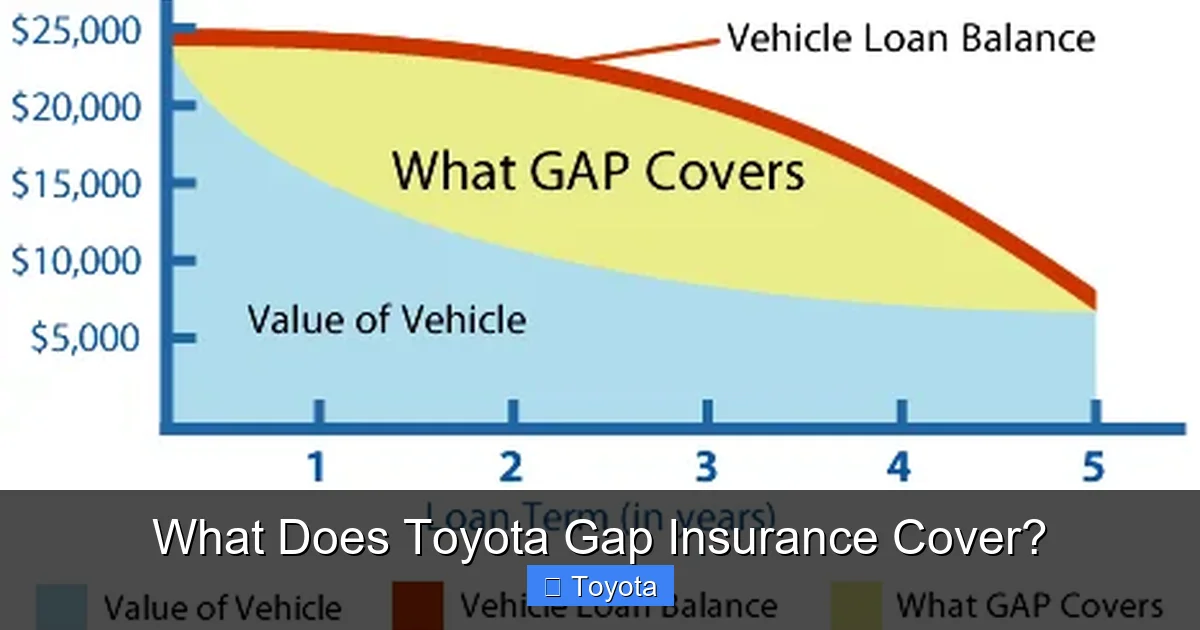
Toyota GAP insurance pays the difference between what your car is worth and what you still owe when it’s totaled or stolen. It kicks in only after your regular auto insurer pays out, and it can wipe out thousands in leftover loan debt. It does not cover missed payments, late fees, or mechanical breakdowns — and you usually need to buy it when you finance the car.
You just drove your new Toyota off the lot. It feels great. Then, six months later, someone runs a red light and the car is totaled. Your insurance company hands you a check for what the car was worth — and it’s thousands less than what you still owe on the loan.
That gap is exactly what Toyota GAP insurance is designed to close. It’s one of those add-ons that people sign for at the finance desk without fully understanding, then forget about until the moment they desperately need it.
So let’s break it down in plain English. What does Toyota GAP insurance actually cover? What does it leave out? And is it worth the money? By the end of this article, you’ll know exactly where you stand.
Key Takeaways
- It covers the gap, not the car: Toyota GAP insurance pays the difference between your vehicle’s actual cash value and your remaining loan or lease balance after a total loss.
- Your primary insurer pays first: GAP only activates after your collision or comprehensive policy settles — it never replaces standard auto insurance.
- It’s not a repair plan: Mechanical failures, wear items, and maintenance costs are never covered by GAP.
- Timing matters: Most Toyota GAP policies must be added when you buy or lease the vehicle, and some lenders require it on long loans with small down payments.
- You can cancel for a refund: If you sell the car or pay off the loan early, you can typically cancel and get a prorated refund on the unused portion.
- It’s optional: You can often find cheaper GAP coverage through your auto insurer or a credit union.
- Read the exclusions: Late fees, missed payments, and negative equity rolled over from a previous loan are commonly excluded.
📑 Table of Contents
What Is Toyota GAP Insurance?
GAP stands for Guaranteed Auto Protection. Sometimes it’s called GAP insurance, GAP coverage, or loan/lease gap coverage. Toyota offers it through Toyota Financial Services and participating dealerships, usually as an add-on when you finance or lease a new or used Toyota.
The idea is simple. Cars lose value fast. A new Camry might drop 20% in value in the first year. But your loan balance doesn’t drop at the same speed — especially if you put little or nothing down or stretched the payments over 72 or 84 months. That creates a gap.
How GAP Coverage Actually Works
Here’s the sequence of events. Your Toyota gets totaled in an accident or stolen and never recovered. Your regular auto insurance company pays you the actual cash value (ACV) of the vehicle — what it was worth on the day of the loss, not what you paid for it.
If that ACV check is smaller than your remaining loan or lease balance, GAP coverage steps in and pays the difference, minus any deductible or limits in your contract. You walk away owing nothing on a car you no longer have.
GAP Insurance vs. Your Regular Auto Policy
These two products do completely different jobs. Your auto policy covers damage, theft, and liability. GAP insurance covers your loan. It’s a financial safety net, not a vehicle protection plan.
People often confuse GAP with extended warranties and prepaid maintenance. If you’re trying to sort out which add-on does what, our guide on what the Toyota Vehicle Protection Package includes helps clear up the difference between coverage that fixes the car and coverage that protects your wallet.
What Toyota GAP Insurance Covers
Now for the main event. Here’s what’s typically included in a Toyota GAP policy.
The Core Promise: The Difference
The primary benefit is straightforward. Toyota GAP insurance covers the difference between your insurance settlement and your outstanding loan or lease balance. That’s it. That’s the whole product.
If your insurer pays $18,000 and you owe $23,500, GAP covers the $5,500 difference. Without it, that $5,500 doesn’t disappear — you’d still owe it to the lender even though the car is gone.
Your Insurance Deductible
Many Toyota GAP contracts also reimburse your primary insurance deductible, up to a set amount — often $500 or $1,000. So if you carry a $1,000 deductible and the car is totaled, GAP may cover that too. Not every policy includes this, so check your contract language carefully.
Lease Balances and Early Termination Fees
If you lease a Toyota, GAP coverage can be especially valuable. Leases often include early termination charges and remaining payment obligations if the vehicle is totaled. Many Toyota GAP policies cover those costs up to your contract limit.
Coverage Limits
There’s always a ceiling. Toyota GAP policies typically cap the payout at a percentage of the vehicle’s original value — commonly somewhere between 120% and 150% of MSRP or the original loan amount. If your gap exceeds that cap, you’re responsible for the rest.
A Real-World Example
Let’s say you buy a new RAV4 for $34,000 with $1,000 down and a 72-month loan. Eighteen months later, it’s totaled. Your insurer values it at $26,000. You still owe $29,800.
Without GAP, you owe $3,800 out of pocket on a car sitting in a salvage yard. With Toyota GAP insurance, that $3,800 gets paid, and you start fresh with a clean slate. That’s the entire value proposition in one scenario.
What Toyota GAP Insurance Does Not Cover
This is where people get surprised. GAP coverage is narrow by design. Here’s what it won’t touch.
Common Exclusions
- Missed or late payments: If you fell behind on the loan, those past-due amounts and late fees usually aren’t covered.
- Negative equity from a previous car: If you rolled $4,000 of old loan debt into your new Toyota loan, many GAP policies exclude that portion.
- Mechanical breakdowns: A blown transmission is not a total loss. GAP pays nothing.
- Extended warranties and add-ons: Service contracts, tire packages, and paint protection rolled into your loan are often excluded from the gap calculation.
- Aftermarket parts and modifications: Lift kits, custom wheels, and audio upgrades generally aren’t factored into the value.
- Down payment recovery: GAP doesn’t refund your down payment. It only settles the loan.
- Credit insurance and other finance charges: These are usually excluded from the covered balance.
When Your Coverage Can Be Denied
GAP only works if your primary insurer actually pays a total loss claim. If your claim is denied for fraud, if you let your comprehensive and collision coverage lapse, or if the loss falls outside your policy terms, GAP won’t step in either.
You also need to keep up with routine maintenance to stay in good standing on many contracts. That means oil changes, tire rotations, and the services listed in your owner’s manual. Our guide on what kind of oil a 2002 Toyota Camry takes is a good reminder that basic upkeep is cheap compared to the cost of a denied claim.
How Much Does Toyota GAP Insurance Cost?
Pricing varies by dealer, state, vehicle, and loan terms. In general, expect to pay somewhere between $400 and $900 as a one-time charge, though some dealers price it higher. It’s usually rolled into your loan, which means you’re paying interest on it too.
That last part matters. A $700 GAP policy financed over 60 months at 6% APR costs more than $700 by the time you’re done. Ask the finance manager for the out-the-door price of the coverage itself, not just the monthly bump.
If you’re a first-time buyer working with a tight budget, it helps to know what financing help exists before you sit down at the desk. Our article on whether Toyota has a first-time buyers program covers the options worth asking about.
Is Toyota GAP Insurance Worth It?
There’s no universal answer, but there are clear situations where it pays off and clear situations where it doesn’t.
When It Makes Sense
- You put little or nothing down. A small down payment means you start upside down immediately.
- You financed for 60 months or longer. Long loans depreciate slower than the car does.
- You leased the vehicle. Lease gap protection can save you from early termination charges.
- You bought a model with steep depreciation. Some trims and body styles lose value faster than others.
- You drive a lot. High mileage accelerates depreciation and widens the gap.
When You Can Skip It
- You paid cash. No loan, no gap.
- You put 20% or more down. You’re likely equity-positive from day one.
- Your loan is nearly paid off. The gap shrinks to almost nothing over time.
- You have savings to cover a surprise. If you could write a $4,000 check tomorrow, self-insuring is reasonable.
One more thing to consider: if you’re already weighing add-ons, it helps to know how the dealership handles payment for other services. Our piece on whether Toyota offers payment plans for service gives you a sense of how flexible the finance office can be.
Canceling Your Toyota GAP Insurance
You’re not locked in forever. If you sell the vehicle, pay off the loan early, or refinance, you can typically cancel your GAP coverage and receive a prorated refund for the unused portion.
To do it, contact the dealer or Toyota Financial Services directly. Ask for the cancellation in writing and confirm the refund amount and timeline. Keep a copy of everything. Refunds are usually applied to your loan balance first, which is fine — it just reduces what you owe.
There’s often a short window after purchase, sometimes 30 days, where you can cancel for a full refund. Ask about it at signing if you’re on the fence.
Alternatives to Dealership GAP Coverage
You have options beyond the finance office. Many major auto insurers sell loan/lease gap coverage as a cheap add-on to your existing policy — often just a few dollars a month. Credit unions and some online lenders also offer it.
The tradeoff is convenience. Dealer GAP is bundled into your loan and handled in one place. Third-party GAP may be cheaper but requires more legwork. Compare at least two quotes before you sign.
The Bottom Line
Toyota GAP insurance covers one specific thing: the difference between what your car is worth and what you still owe when it’s totaled or stolen. It doesn’t fix the car, it doesn’t cover repairs, and it doesn’t pay your bills if you fall behind.
For drivers with long loans, small down payments, or leases, it’s genuinely useful protection. For buyers with solid equity or cash in the bank, it’s often unnecessary.
Either way, don’t sign blind. Ask for the price, the cap, the exclusions, and the cancellation policy. Five minutes of questions at the finance desk can save you thousands later — or save you from paying for coverage you’ll never use.
Frequently Asked Questions
Does Toyota GAP insurance cover the full loan balance?
Not always. It covers the difference between your insurance settlement and your loan balance, but only up to the cap stated in your contract — often 120% to 150% of the vehicle’s original value. Missed payments, late fees, and rolled-over negative equity are usually excluded from that calculation.
Is Toyota GAP insurance required to buy a Toyota?
No, it’s optional in most cases. Some lenders may require it on certain high-risk loans, like those with very little down and long terms, but you can generally decline it. You can also buy gap coverage from your auto insurer or credit union instead.
Does GAP insurance cover mechanical problems or engine failure?
No. GAP coverage only applies after a total loss, such as a serious accident or theft. Mechanical failures, engine damage, and transmission problems are never covered — those fall under your warranty or an extended service contract.
Can I get a refund if I cancel my Toyota GAP insurance?
Yes, in most cases. If you pay off your loan early, sell the vehicle, or refinance, you can cancel and receive a prorated refund for the unused portion of the coverage. Request the cancellation in writing and confirm the refund amount before you finalize anything.
Does GAP insurance cover my deductible?
Many Toyota GAP policies do reimburse your primary insurance deductible, typically up to $500 or $1,000. It’s not universal, though, so check your specific contract. If deductible coverage matters to you, ask about it before you sign.
What happens if I don’t have GAP insurance and my car is totaled?
You’d still owe your lender the difference between the insurance payout and your remaining loan balance — out of pocket, immediately. That amount doesn’t go away just because the car is gone, and it can follow you into your next auto loan as negative equity.